View all questions & answers for the NSE 7 - Secure Networking 7.6 Architect Exam Materials exam


NSE 7 - Secure Networking 7.6 Architect Exam Materials-Question 1 Discussion
Comment Image Comment Image Comment Image

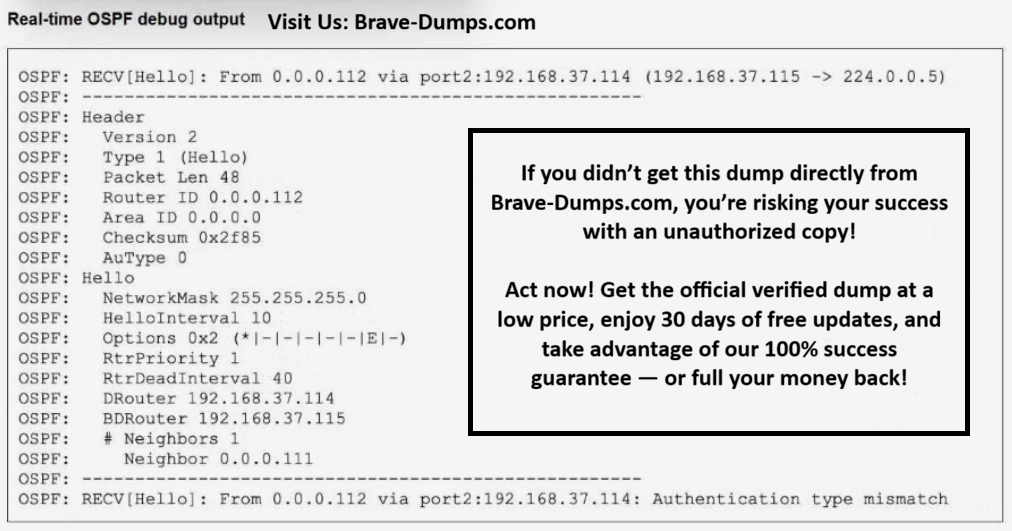
Refer to the exhibit. Partial output of a real-time OSPF debug is shown. Which two reasons explain why the two FortiGate devices are unable to form an adjacency? (Choose two answers)

  • A. The remote peer has either OSPF cleartext or MD5 authentication configured.
  • B. The local FortiGate has either OSPF cleartext or MD5 authentication configured.
  • C. There is an OSPF authentication configuration mismatch.
  • D. The local FortiGate does not have OSPF authentication configured.
Correct Answer: B,C

Brave-Dump Clients Votes

BC 75%
AC 25%

Comments


Md Nasir Uddin 2026-08-16 15:19:06

Selected Answers: B, C


Authentication configuration mismatch. Neigbour routter does not configure any authuntication showing authTpe 0 mean no cleartext or MD5 configured


marek Marucha 2026-09-14 21:44:38

Selected Answers: A, C


Remote Peer Configuration: In the header section of the received Hello packet, the field AuType is listed as 0 (Null/No authentication), while the error message indicates a mismatch. This means the remote peer (0.0.0.112) sent a Hello packet with no authentication (AuType 0), whereas the local Fortigate receiving the packet expects OSPF cleartext (AuType 1) or MD5 (AuType 2) authentication, or vice versa—meaning the remote peer is sending authentication (cleartext/MD5) while the local side expects none, or the remote sent cleartext/MD5 (AuType 1 or 2) and the local side has none or a different type configured (Option A).


Luis 2026-09-15 19:23:14

Selected Answers: B, C


Remote peer (0.0.0.112) send null (no authentication) in hello packet, and local FGT debug shows "auth type mistmach"; so local FGT expects Cleartext (autype 1) or MD5 (autype 2).


Anonymous User 2026-10-07 21:31:31

Selected Answers: B, C


ans B and C