View all questions & answers for the NSE 7 - Enterprise Firewall 7.6 Administrator Exam Materials exam
Comments
Selected Answers: A, D
-
Brave-Dumps.com Admin
2025-11-27 22:07:50
please explain why
Selected Answers: A, D
-
Miguel
2025-12-29 14:24:26
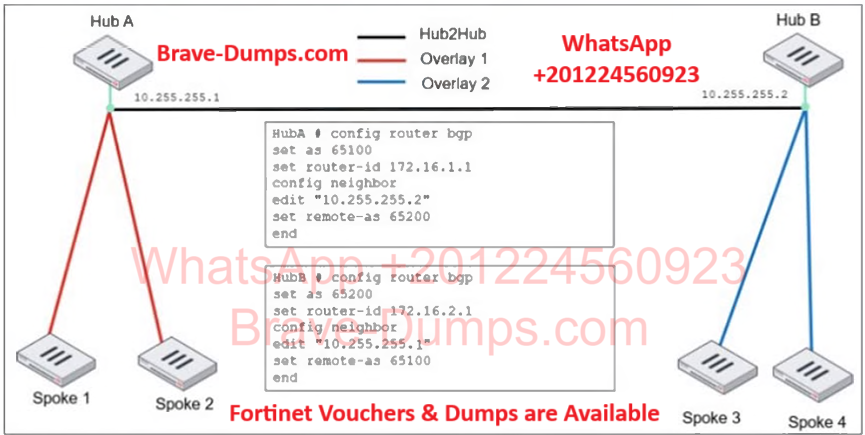
Default BGP Behavior: When a BGP router advertises a route to a neighbor, it usually changes the next-hop attribute to its own IP address. This means if Hub A receives routes from Spoke 1 and Spoke 2 and then advertises them to Hub B, the next-hop will default to Hub A’s IP (10.255.255.1). Problem in the Shown Topology: Spokes (Spoke 1 and Spoke 2) are behind Hub A, and Spoke 3 and Spoke 4 are behind Hub B. If Hub A changes the next-hop when sending routes to Hub B, Hub B will think the next hop to reach Spoke 1 is Hub A. This breaks routing logic because in SD-WAN or VPN networks, spokes need to keep the original next-hop so traffic flows correctly through the tunnels. Solution with set attribute-unchanged next-hop: This command tells the BGP process not to modify the next-hop attribute when redistributing routes to its neighbor. As a result, Hub A advertises Spoke 1 and Spoke 2 routes to Hub B keeping the original next-hop (the spoke’s IP). This ensures Hub B knows that traffic to Spoke 1 should go directly through the correct tunnel, not via Hub A unnecessarily. Conclusion: In a Hub-and-Spoke architecture using BGP, preserving the original next-hop is critical for proper spoke-to-spoke communication without forcing traffic through the hub. That’s why the correct option is “set attribute-unchanged next-hop”.
Selected Answers: B, D
Selected Answers: B, D
Selected Answers: B, D
Selected Answers: B, D
set attribute-unchanged next-hop
set ebgp-enforce-multihop enable
Selected Answers: B, D
Selected Answers: B, D
Selected Answers: B, D
Selected Answers: B, D
Selected Answers: B, D
Refer to the exhibit. An ADVPN network is shown. You must configure an ADVPN using IBGP for each local region and EBGP across regions to connect Overlay 1 with Overlay 2. Which two options must you configure in the Hub2Hub BGP peering? (Choose two answers)
Brave-Dump Clients Votes