View all questions & answers for the NSE 7 - Enterprise Firewall 7.6 Administrator Exam Materials exam
Comments
Selected Answers: A
Selected Answers: D
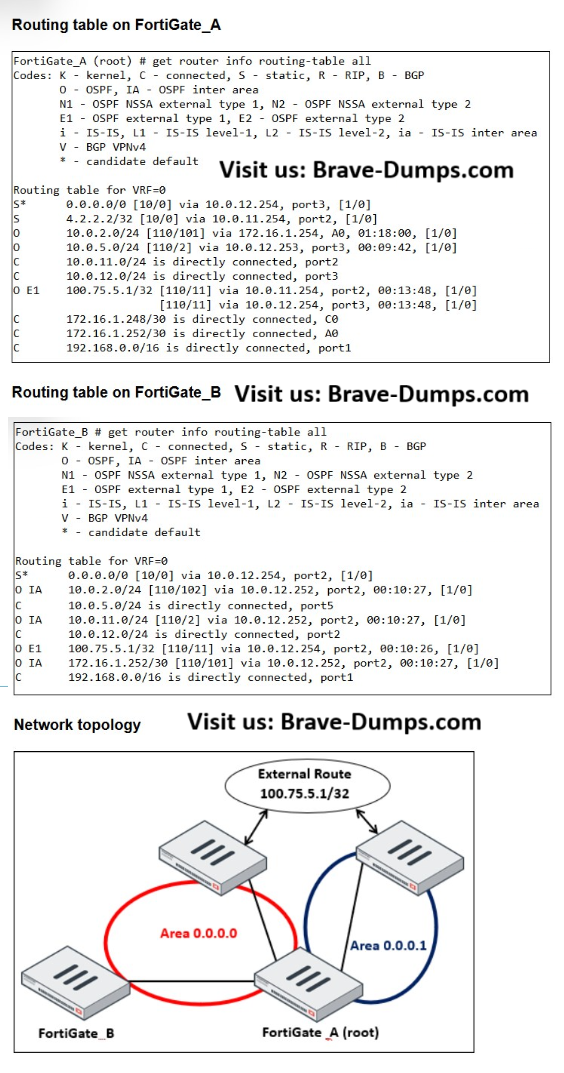
In FortiGate B, we can see only 10.0.12.0/24 is directly connected network, so only above left router can be OSPF neighbor
ECMP can work with modern RFC 2328.
RFC1583 is just recommended when we have ASBR to depend only on cost, but it doesn't mean ECMP works only with RFC1583, so I think A is wrong.
B is wrong because both routes have same metric 11.
C is wrong because FortiGate A doesn't advertise it, the external network is advertised from ASBRs (both above routers in the exhibit) directly and that advertisement goes to all OSPF routers in all areas as LSA Type 5.
D seems to be the most correct answer to me, so the above right router is just not OSPF neighbor, so it can't be next hop.
What do you think?
Selected Answers: C
A Incorrect ,RFC-1583 compatibility affects cost calculation for external routes but doesn't reduce the number of paths visible to FortiGate_B
B Incorrect , Lowest cost would affect which path is chosen but wouldn't explain why only one path exists — ECMP would still show multiple if they were equal cost
D incorrect 10.0.11.0/24 being outside FortiGate_B's area is irrelevant to the external route count for 100.75.5.1/32
Selected Answers: A
Selected Answers: C
Selected Answers: A
RFC 1583 enables Equal-Cost Multi-Path (ECMP) routing in OSPF by allowing a router to install multiple equal-cost paths to the same destination in the routing table. Its key ECMP capability is simplified path selection based solely on cost, without considering route type hierarchy.
As in this question the route seems to be coming via intra and inter area, enabling RFC 1583 allows the fortigate to install both route types instead of preferring one over the other as is the default behavior.
Selected Answers: A
Refer to the exhibits. The routing tables of FortiGate_A and FortiGate_B and a network topology are shown. Why does FortiGate_B have only one external route available to 100.75.5.1/32? (Choose one answer)
Brave-Dump Clients Votes