View all questions & answers for the NSE 6 - Network Security 7.6 Support Engineer Materials exam
NSE 6 - Network Security 7.6 Support Engineer Materials-Question 33 Discussion
Comments
Selected Answers: A
FGT-2 in the stub area will advertise its LSA Type 1 and 2 routes normally to ABR FGT-1, and ABR FGT-1 will advertise them as LSA Type 3 to FGT-3, so this route advertisement out of stub area should be fine?
-
Fatma Salih
2026-01-21 20:30:40
It doesn’t explain it. -
Fatma Salih
2026-01-21 21:10:29
If it was that FGT 2 is the one that doesn’t receive the routes from 3 it would’ve made total sense.
Selected Answers: A
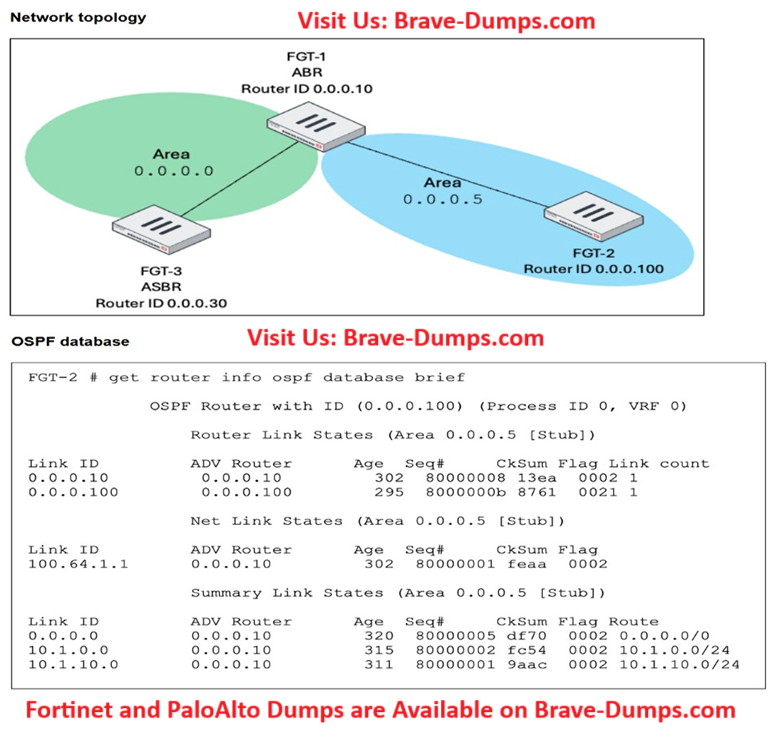
Refer to the exhibits. FGT-1 is an area border router (ABR) that has interfaces in OSPF areas 0.0.0.0 and 0.0.0.5. FGT-3 acts as an autonomous system border router (ASBR), importing static routes into OSPF. FGT-2 is an internal router with all its interfaces belonging to area 0.0.0.5. FGT-1 is receiving all advertised routes from FGT-2, however, FGT-3 is not receiving any of the advertised routes from FGT-1. What is the most likely reason for this? (Choose one answer)
Brave-Dump Clients Votes