View all questions & answers for the NSE 6 - Network Security 7.6 Support Engineer Materials exam
NSE 6 - Network Security 7.6 Support Engineer Materials-Question 55 Discussion
Comments
Selected Answers: B
Why this is the correct answer:
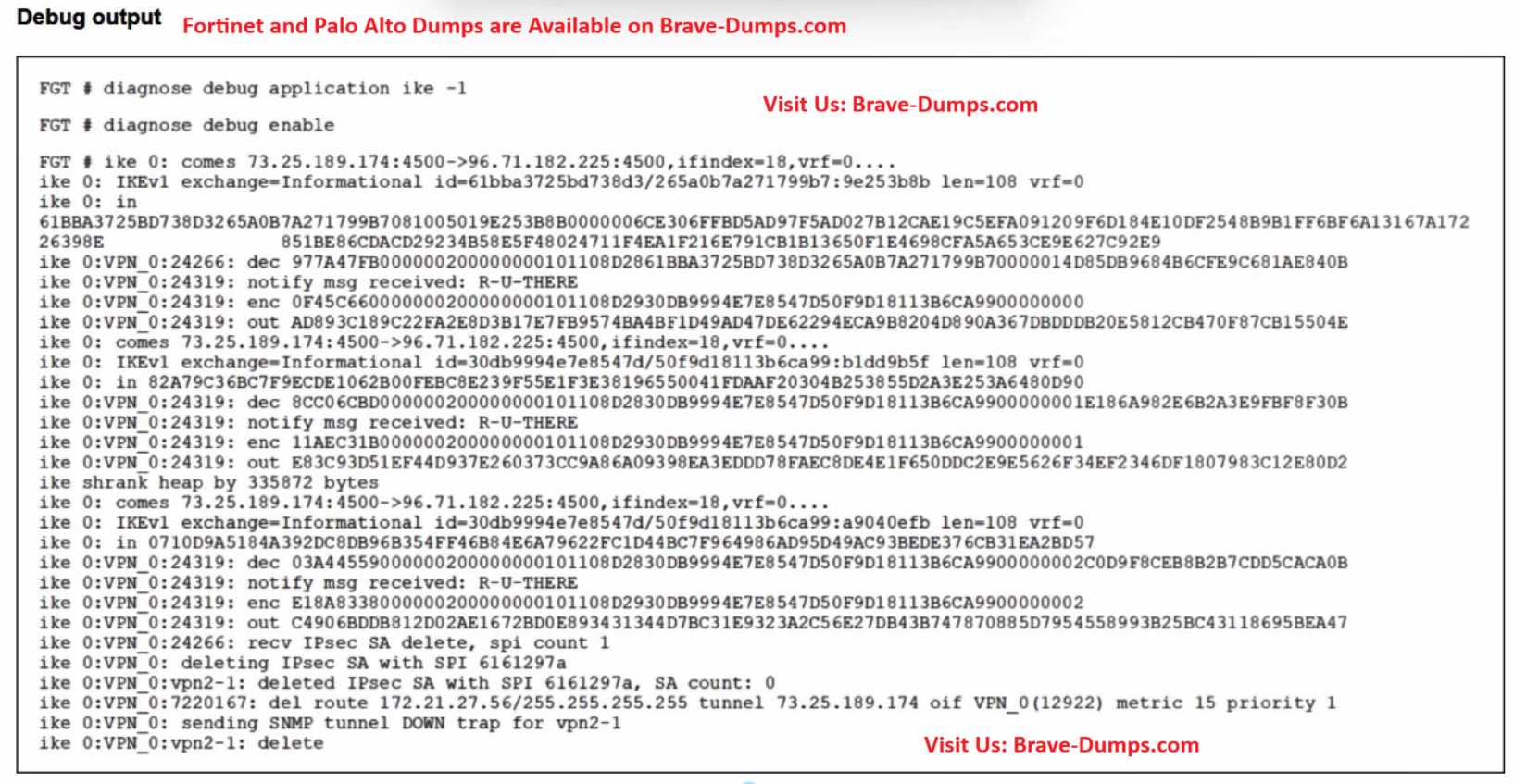
Analyzing the IKE real-time debug (diagnose debug application ike -1), we can see a specific pattern of Dead Peer Detection (DPD) failure:
DPD Messages: The logs show multiple lines stating notify msg received: R-U-THERE. This indicates that the remote peer is querying the FortiGate to see if it is still alive.
Lack of Acknowledgement: While we see the "Are you there" messages, the output further down shows the tunnel being torn down: ike 0:VPN_0: deleting IPsec SA.
The "Silent" Failure: In IKEv1 (which this log identifies as IKEv1 exchange), if one side sends DPD queries and does not receive the expected R-U-THERE-ACK (acknowledgement) within the configured retry limit and timeout, it assumes the neighbor is dead.
Consequence: Once the DPD threshold is reached without a response, the FortiGate clears the SAs (Security Associations) and deletes the routes, as seen in the line: del route 172.21.27.56/255.255.255.255 tunnel 73.25.189.174.
Why the other options are incorrect:
A: NAT-T is clearly working, as the communication is happening over port 4500 (the standard port for NAT Traversal).
C: The route is being deleted because the tunnel went down; the lack of a route is a result of the failure, not the cause.
D: The FortiGate is clearly receiving packets (as evidenced by the comes 73.25.189.174:4500 and recv IPsec SA delete lines), so it is not dropping all incoming IKE traffic.
Refer to the exhibit. An IPsec VPN tunnel is dropping, as shown by the debug output. Analyzing the debug output, what could be causing the tunnel to go down? (Choose one answer)
Brave-Dump Clients Votes