View all questions & answers for the NSE 6 - Network Security 7.6 Support Engineer Materials exam


NSE 6 - Network Security 7.6 Support Engineer Materials-Question 107 Discussion

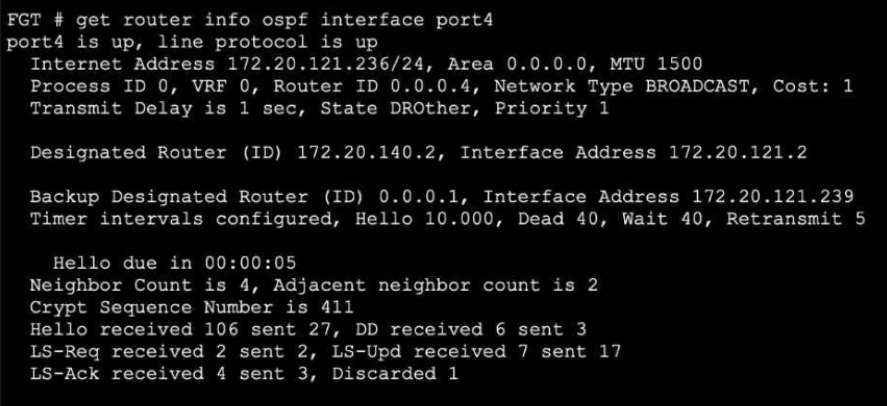
Refer to the exhibit, which shows the output of a debug command. Which two statements about the output are true? (Choose two answers)

  • A. The interface is part of the OSPF backbone area.
  • B. There are a total of five OSPF routers attached to the Port4 network segment.
  • C. One of the neighbors has a router ID of 0.0.0.4.
  • D. In the network connected to port4, two OSPF routers are down.
Correct Answer: A,B

Brave-Dump Clients Votes

AB 75%
AD 25%

Comments


James 2026-01-26 04:28:42

Selected Answers: A, D


Neighbor Count is 4, Adjacent neighbor count is 2
4 neighbors − 2 adjacent = 2 neighbors not fully formed


Mehdi 2026-02-13 17:15:00

Selected Answers: A, B


Adjacent doesn't mean down


andre130480 2026-03-23 14:45:44

Selected Answers: A, B


man, it is a DRother so fully adjacency with DR, BDR


Anonymous User 2026-04-05 03:27:53

Selected Answers: A, B


A. The interface is part of the OSPF backbone area.The Evidence: Looking at the second line of the output, it explicitly states: Area 0.0.0.0.The Logic: In OSPF, Area 0 (or 0.0.0.0) is officially defined as the Backbone Area. All other areas must connect to this area to exchange routing information.B. There are a total of five OSPF routers attached to the Port4 network segment.The Evidence: Look at the line: Neighbor Count is 4.The Logic: The "Neighbor Count" represents the other OSPF routers that the local FortiGate sees on that specific segment. Since the local FortiGate itself is also an OSPF router on that segment, you add the local router (1) to the neighbors (4). 1 (Local FGT)} + 4 (Neighbors) = 5 Total Routers