View all questions & answers for the NSE 5 - FortiSwitch 7.6 Administrator Exam Materials exam
NSE 5 - FortiSwitch 7.6 Administrator Exam Materials-Question 20 Discussion
Comments
Selected Answers: C
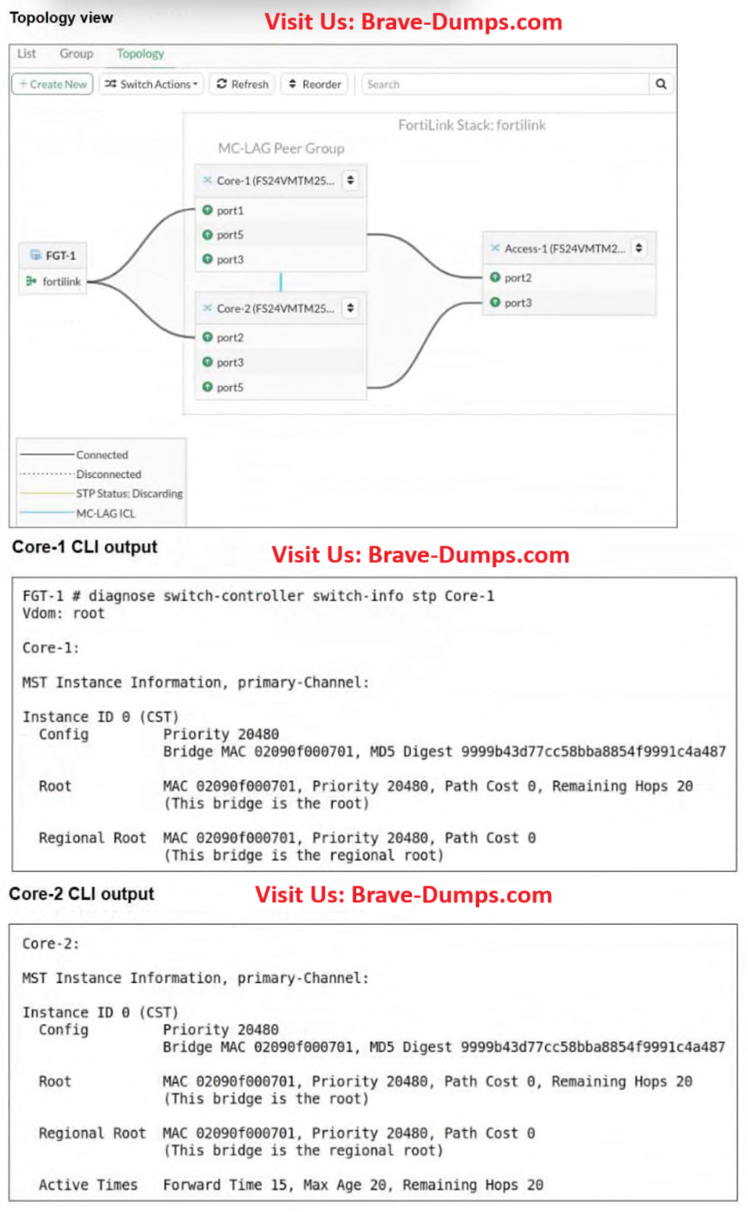
The correct answer is C because the CLI outputs clearly show that both Core-1 and Core-2 share the exact same Bridge MAC address of 02090f000701. While standard switches each possess a unique Bridge ID, the MCLAG configuration synchronizes these parameters to allow the two physical devices to function as a single logical switch. This shared identity ensures that downstream devices view them as one unit for redundancy and loop prevention. Consequently, because this shared logical identity has the lowest Bridge ID in the network, both switches report that they are the root bridge.
Refer to the exhibits. An administrator has deployed two FortiSwitch devices, Core-1 and Core-2, as multichassis link aggregation group (MCLAG) peers. These switches are connected to FortiGate for FortiLink and to an access switch (Access-1) using an inter-switch link (ISL). After configuration, the administrator notices that both Core-1 and Core-2 are claiming to be the root bridge in the Multiple Spanning Tree Protocol (MSTP) topology. What explains this behavior? (Choose one answer)
Brave-Dump Clients Votes