View all questions & answers for the BIG-IP Administration Data Plane Configuration (F5CAB3) exam
BIG-IP Administration Data Plane Configuration (F5CAB3)-Question 46 Discussion
Comments
Selected Answers: A
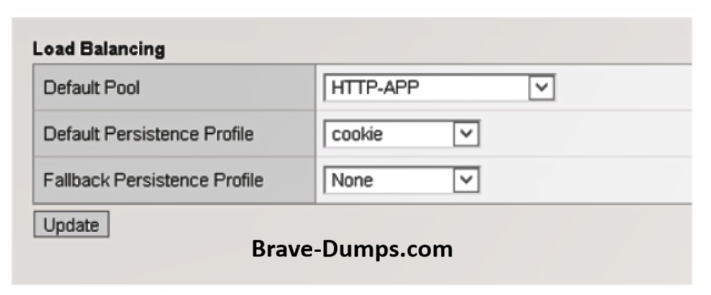
The image shows a Virtual Server Load Balancing configuration with:
Default Persistence Profile: cookie
Fallback Persistence Profile: None
When an application requires a Fallback Persistence Profile, BIG-IP supports only one persistence type for fallback use:
👉 Universal Persistence
Universal persistence is designed specifically to act as a fallback when the primary persistence method (such as cookies) is unavailable.
Selected Answers: D
• HTTP vs HTTPS
• Missing cookies
• Broken headers
• API vs browser
• Mobile vs desktop
• Encrypted payloads
It’s the only persistence method that is universally safe as fallback.
-
Brave-Dumps.com Admin
2026-02-08 23:26:22
Exactly, Thanks
Selected Answers: D
When the default persistence profile is cookie, the appropriate fallback persistence profile is Source Address Affinity. Cookie persistence only works when a client supports cookies; if a client doesn't support cookies, the fallback kicks in — and Source Address Affinity (which tracks clients by IP address) is the standard fallback choice for cookie-based persistence.
Refer to the exhibit. Due to a change in application requirements, a BIG-IP Administrator needs to modify the configuration of a Virtual Server to include a Fallback Persistence Profile. Which persistence profile type should the BIG-IP Administrator use for this purpose? (Choose one answer)
Brave-Dump Clients Votes