View all questions & answers for the FCSS - SD-WAN 7.4 Architect Exam Materials exam
FCSS - SD-WAN 7.4 Architect Exam Materials - Question #28 Discussion
Community Explanations & Comments (2)
michael
1 year ago
Selected: A, B, E
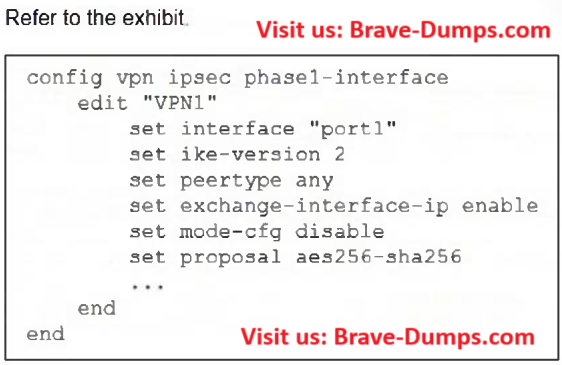
B. The remote end must support IKEv2. this is required based on output.
D. The remote end can be a third-party IPsec device. Exchange IP is proprietary and cant use third party devices.
D. The remote end can be a third-party IPsec device. Exchange IP is proprietary and cant use third party devices.
Mohamed Shaban
1 year ago
Selected: A, B, D
A. The administrator must manually assign the tunnel interface IP address on the hub side.
True – Because mode-cfg is disabled, IP assignment is manual.
B. The remote end must support IKEv2.
True – The configuration explicitly uses ike-version 2.
D. The remote end can be a third-party IPsec device.
True – peertype any allows non-FortiGate devices.
True – Because mode-cfg is disabled, IP assignment is manual.
B. The remote end must support IKEv2.
True – The configuration explicitly uses ike-version 2.
D. The remote end can be a third-party IPsec device.
True – peertype any allows non-FortiGate devices.
Mohamed Shaban
1 year ago
I change my answer to A,B,E
Refer to the exhibit. The administrator configured the IPsec tunnel VPN1 on a FortiGate device with the parameters shown in exhibit. Based on the configuration, which three conclusions can you draw about the characteristics and requirements of the VPN tunnel? (Choose three answers)
Brave-Dump Community Votes