View all questions & answers for the Implementing Cisco Enterprise Network Core Technologies (350-401 ENCOR) Exam Materials exam
Implementing Cisco Enterprise Network Core Technologies (350-401 ENCOR) Exam Materials - Question #61 Discussion
Community Explanations & Comments (1)
Anonymous User
2 hours ago
Can we use any names for the access-list, class-map, and policy-map, or is there a specific naming convention that should be followed?
I couldn't find any specific rule governing their names when using TELNET. How can we determine the correct names to use?
I couldn't find any specific rule governing their names when using TELNET. How can we determine the correct names to use?
Guidelines
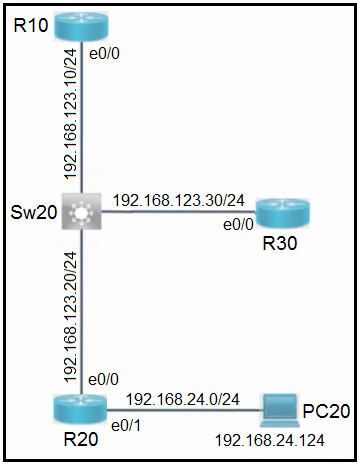
This is a lab item in which tasks will be performed on virtual devices.
Tasks
OSPF is preconfigured on all routers. Configure R10 and R30 to complete these tasks.
Task 1
Modify the existing ACL on R10 so that OSPF routes are received from R20 and R30.
Task 2
Configure CoPP on R30 to achieve these results:
Answers
On R10:
enable
configure terminal
ip access-list extended 120
5 permit ospf any any
exit
end
write memory
R30:
enable
configure terminal
ip access-list extended TELNET
permit tcp 192.168.24.0 0.0.0.255 any eq telnet
exit
class-map match-any TELNET
match access-group name TELNET
exit
policy-map COPP
class TELNET
police 8000 conform-action transmit exceed-action drop
exit
exit
control-plane
service-policy input COPP
exit
end
(Choose the correct answer)write memory
Brave-Dump Community Votes
No community votes submitted yet. Be the first to vote!