View all questions & answers for the NSE 5 - FortiSASE and SD-WAN 7.6 Core Administrator Exam Materials exam
NSE 5 - FortiSASE and SD-WAN 7.6 Core Administrator Exam Materials - Question #50 Discussion
Community Explanations & Comments (2)
Diaa El-rayse
6 months ago
Selected: A, D
The question ask for two reasons that could making this happen , route priority is only considered when we have multiple static routes
Rocky
4 months ago
Selected: A, D
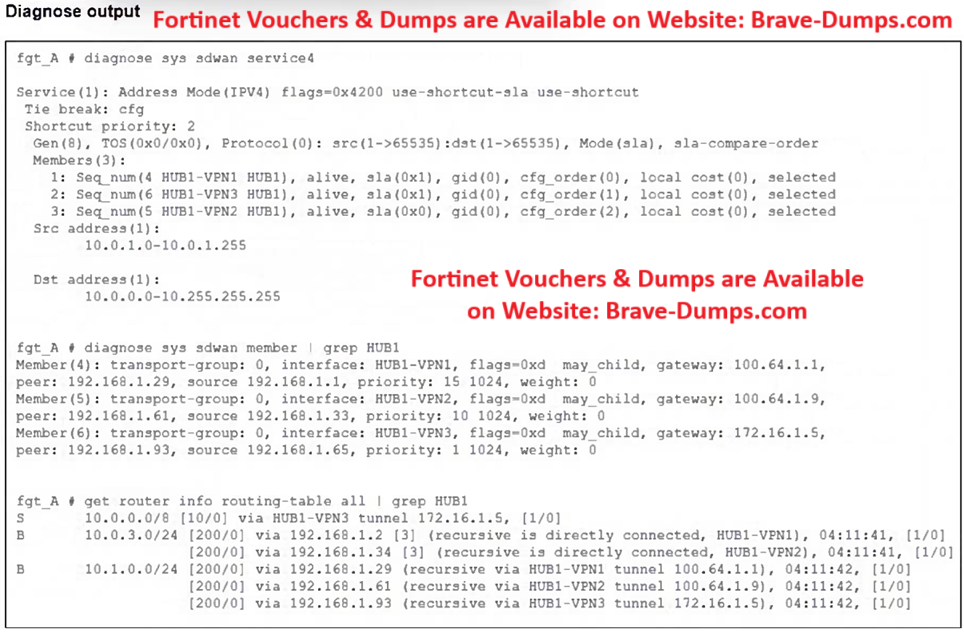
1. Why Option A is Correct (Valid Route Requirement)In FortiOS, for an interface member to be selectable by an SD-WAN rule, it must have a valid active route to the destination within the firewall's main routing table (RIB/FIB).Looking at the third command output (get router info routing-table all | grep HUB1):There is only a valid entry for the target network 10.0.0.0/8 via HUB1-VPN3 (via HUB1-VPN3 tunnel 172.16.1.5).There is no route for the 10.0.0.0/8 network pointing to HUB1-VPN1.Because HUB1-VPN1 lacks a valid routing path to that destination network, the SD-WAN engine automatically bypasses it as an unavailable route.2. Why Option D is Correct (Policy Route Precedence)In the FortiOS packet flow and routing lookup order, regular Policy-Based Routes (PBR) configured under Network > Policy Routes are evaluated before SD-WAN rules.If an administrator previously set up a manual policy route that matches the 10.0.0.0/8 traffic and forces it out via HUB1-VPN3, the firewall will forward the packet instantly using that policy route, completely skipping the SD-WAN ruleset.Why the other options are incorrect:B & C: Even though HUB1-VPN3 shows a member priority value of 1 (which is numerically lower/preferred over 15), the diagnose sys sdwan service 4 output clearly specifies Tie break: cfg (configuration order). Because the rule relies strictly on configuration order rather than member priority weights, interface priority values are ignored during this rule evaluation.
Refer to the exhibit. An administrator is troubleshooting SD-WAN on FortiGate. A device behind branch1_fgt generates traffic to the 10.0.0.0/8 network. The administrator expects the traffic to match SD-WAN rule ID 1 and be routed over HUB1-VPN1. However, the traffic is routed over HUB1-VPN3. Based on the output shown in the exhibit, which two reasons, individually or together, could explain the observed behavior? (Choose two answers)
Brave-Dump Community Votes