View all questions & answers for the NSE 5 - FortiSwitch 7.6 Administrator Exam Materials exam
NSE 5 - FortiSwitch 7.6 Administrator Exam Materials - Question #24 Discussion
Community Explanations & Comments (2)
javaughn Bryan
10 months ago
Selected: C
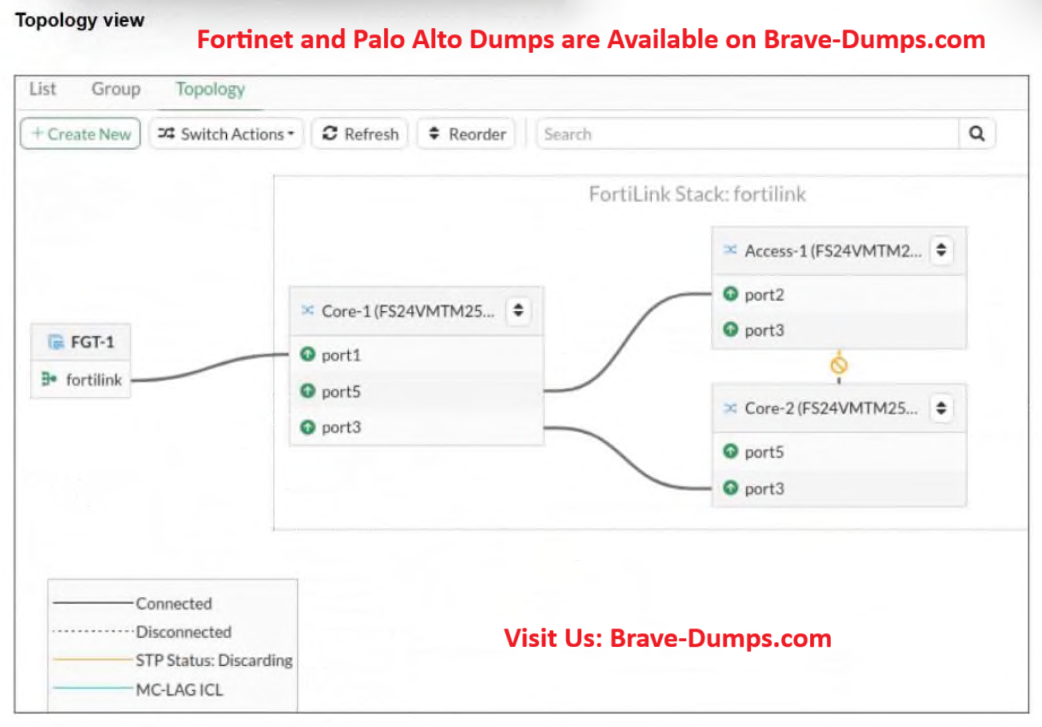
C is absolutely correct. The other options don't explain the beaviour correctly. When you bring up Core-2’s uplinks it likely became the STP root (lowest priority). STP then blocks (puts in Discarding) one of the Access-1 uplinks to prevent a loop.
Harrison Hord
1 week ago
Selected: D
If Core-2 has the lowest bridge priority, that means it is the root switch. On a root switch, all ports are designated, so for Access-1, that port would be the root port and would not be blocked. I think the correct answer is D
Brave-Dumps.com Admin
1 week ago
This is typical Spanning Tree behavior. - Blocking is a spanning tree method.
Therefore, it's running (not D)
Harrison Hord
1 week ago
I agree that STP is involved, but if the correct answer is C, then Core-2 is the Root Bridge, the direct link between Core-2 and Access-1 consists of a Designated Port on Core-2 and a Root Port on Access-1.
Neither side of this direct link will ever be blocked by STP under normal convergence.
Refer to the exhibit. You just connected three FortiSwitch devices: Core-1, Core-2, and Access-1. Core-1 and Core-2 both connect to Access-1 for redundancy. All switches are managed by FortiGate, which uses port4 as the FortiLink interface. After you enable the uplink ports on Core-2, you notice that port3 on Access-1 enters the Discarding STP state. What is the most likely cause of this behavior? (Choose one answer)
Brave-Dump Community Votes