View all questions & answers for the NSE 7 - Enterprise Firewall 7.6 Administrator Exam Materials exam
NSE 7 - Enterprise Firewall 7.6 Administrator Exam Materials - Question #50 Discussion
Community Explanations & Comments (11)
Hasan Ahmed
11 months ago
Selected: A, D
A and D is the Correct Answer
Brave-Dumps.com Admin
11 months ago
please explain why
Shabeeb Kunhipocker
11 months ago
Selected: A, D
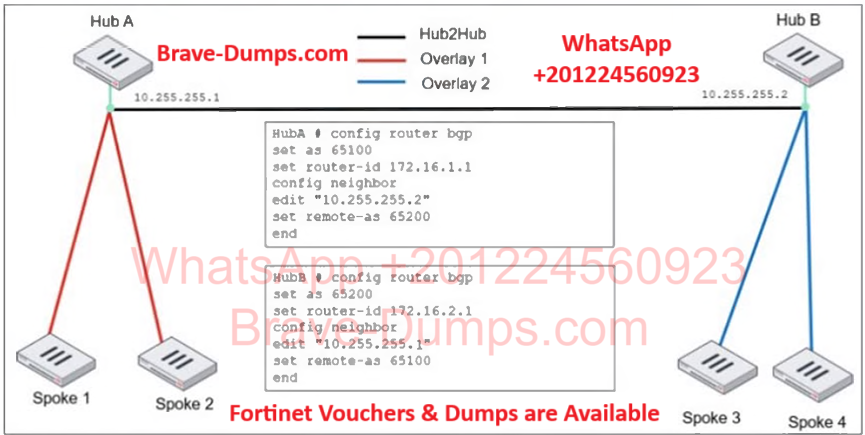
I think A,D since the question is asking for the options to be configured in hub2hub BGP peering (eBGP). The option B will tell to keep the nexthop (spokes' nexthop IPs) unchanged as they will not be reachable across regions.
Miguel
10 months ago
Default BGP Behavior:
When a BGP router advertises a route to a neighbor, it usually changes the next-hop attribute to its own IP address.
This means if Hub A receives routes from Spoke 1 and Spoke 2 and then advertises them to Hub B, the next-hop will default to Hub A’s IP (10.255.255.1).
Problem in the Shown Topology:
Spokes (Spoke 1 and Spoke 2) are behind Hub A, and Spoke 3 and Spoke 4 are behind Hub B.
If Hub A changes the next-hop when sending routes to Hub B, Hub B will think the next hop to reach Spoke 1 is Hub A.
This breaks routing logic because in SD-WAN or VPN networks, spokes need to keep the original next-hop so traffic flows correctly through the tunnels.
Solution with set attribute-unchanged next-hop:
This command tells the BGP process not to modify the next-hop attribute when redistributing routes to its neighbor.
As a result, Hub A advertises Spoke 1 and Spoke 2 routes to Hub B keeping the original next-hop (the spoke’s IP).
This ensures Hub B knows that traffic to Spoke 1 should go directly through the correct tunnel, not via Hub A unnecessarily.
Conclusion:
In a Hub-and-Spoke architecture using BGP, preserving the original next-hop is critical for proper spoke-to-spoke communication without forcing traffic through the hub. That’s why the correct option is “set attribute-unchanged next-hop”.
Mike
10 months ago
Selected: B, D
B, D. Study guide page 236
Capi
10 months ago
Selected: B, D
For me its B and D as per page 236. Option b will keep the next hop unchanged so there aren't issues with setting up advpn for example. Option D allows BGP messages to reach the dest if there are more L3 equipments in the middle
Anonymous User
10 months ago
Selected: B, D
I already explained that in **Shabeeb Kunhipocker’s comment**.
Adam
9 months ago
Selected: B, D
Page 236 of Study Guide mentions same use case with requirement to configure the below under eBGP neighbor:
set attribute-unchanged next-hop
set ebgp-enforce-multihop enable
set attribute-unchanged next-hop
set ebgp-enforce-multihop enable
zineeddine Mohamed
7 months ago
Selected: B, D
PAGE 236
Mohamed Gamal Mahmoud
7 months ago
Selected: B, D
b.d
Anonymous User
6 months ago
Selected: B, D
Enterprise_Firewall_7.6_Administrator_Study_Guide page 236
Anonymous User
6 months ago
Selected: B, D
Enterprise_Firewall_7.6_Administrator_Study_Guide page 236
Anonymous User
4 months ago
Selected: B, D
Study Guide Page 237
Refer to the exhibit. An ADVPN network is shown. You must configure an ADVPN using IBGP for each local region and EBGP across regions to connect Overlay 1 with Overlay 2. Which two options must you configure in the Hub2Hub BGP peering? (Choose two answers)
Brave-Dump Community Votes