● FCP - FortiClient EMS 7.2 Administrator Exam Materials
Please note that the exam "FCP - FortiClient EMS 7.2 Administrator" is no longer offered by Fortinet and is not available for booking through Pearson VUE, so we opened it on free view,
It has been replaced by the exam " NSE 6 - FortiClient EMS 7.4 Administrator Exam"
The new exam version is available on Brave-Dumps and can be purchased.
It has been replaced by the exam " NSE 6 - FortiClient EMS 7.4 Administrator Exam"
The new exam version is available on Brave-Dumps and can be purchased.
Question #41
Question #42
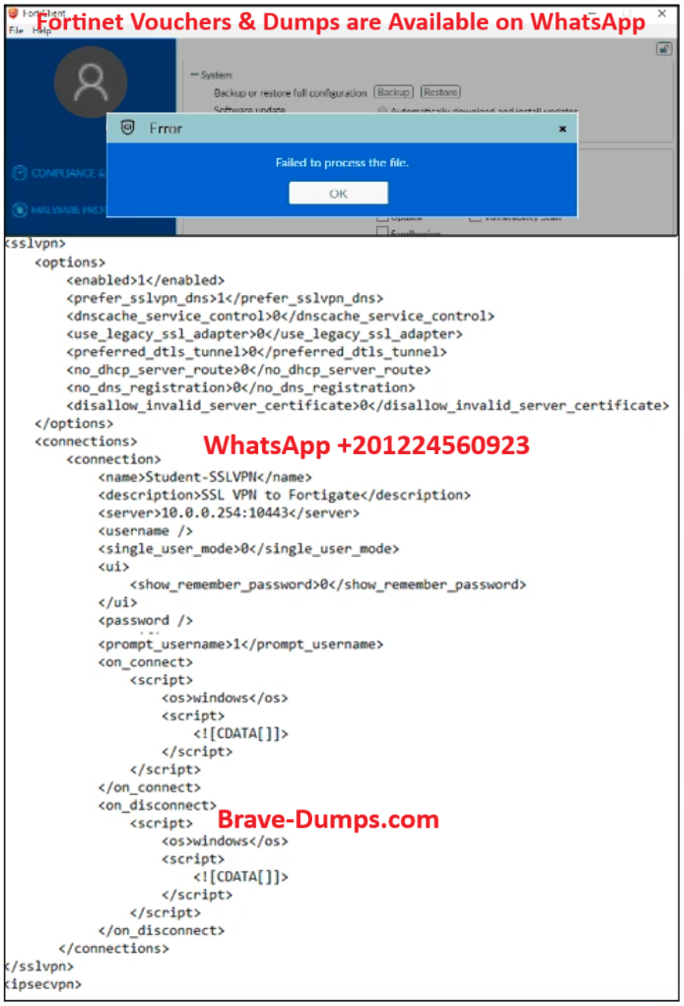
An administrator has restored the modified XML configuration file to FortiClient and sees the error shown in the exhibit.
Based on the XML settings, what must the administrator do to resolve the issue with the XML configuration file?
(Choose one answer)
- A. The administrator must use a password to decrypt the file.
- B. The administrator must resolve the XML syntax error.
- C. The administrator must save the file as FortiClient-config.conf.
- D. The administrator must change the file format.
Question #43
Which statement about the FortiClient enterprise management server is true? (Choose one answer)
- A. It receives the configuration information of endpoints from FortiGate.
- B. It provides centralized management of multiple endpoints running FortiClient software.
- C. It receives the CA certificate from FortiGate to validate client certificates.
- D. It enforces compliance on the endpoints using tags.
Question #44
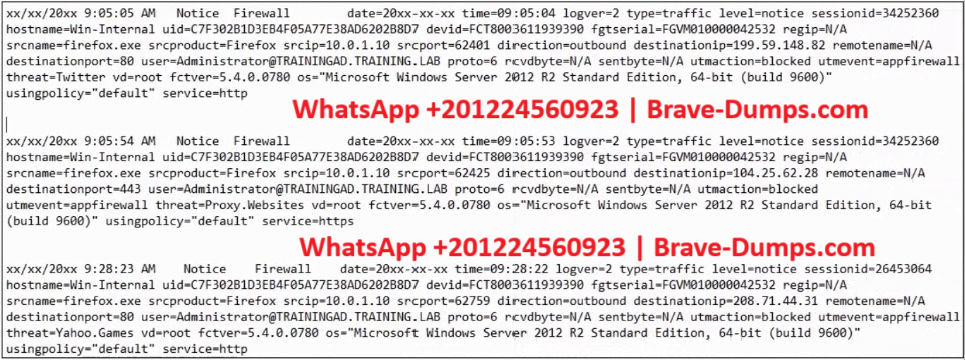
Refer to the exhibit.
Based on the FortiClient logs shown in the exhibit which application is blocked by the application firewall?
(Choose one answer)
- A. Twitter
- B. Facebook
- C. Internet Explorer
- D. Firefox
Question #45
An administrator installs FortiClient on Windows Server.
What is the default behavior of real-time protection control?
(Choose one answer)
- A. Real-time protection must update AV signature database
- B. Real-time protection sends malicious files to FortiSandbox when the file is not detected locally
- C. Real-time protection is disabled
- D. Real-time protection must update the signature database from FortiSandbox
Question #46
Which three types of antivirus scans are available on FortiClient? (Choose three answers)
- A. Proxy scan
- B. Full scan
- C. Custom scan
- D. Flow scan
- E. Quick scan
Question #47
Which component or device shares device status information through ZTNA telemetry? (Choose one answer)
- A. FortiClient
- B. FortiGate
- C. FortiGate Access Proxy
- D. FortiClient EMS
Question #48
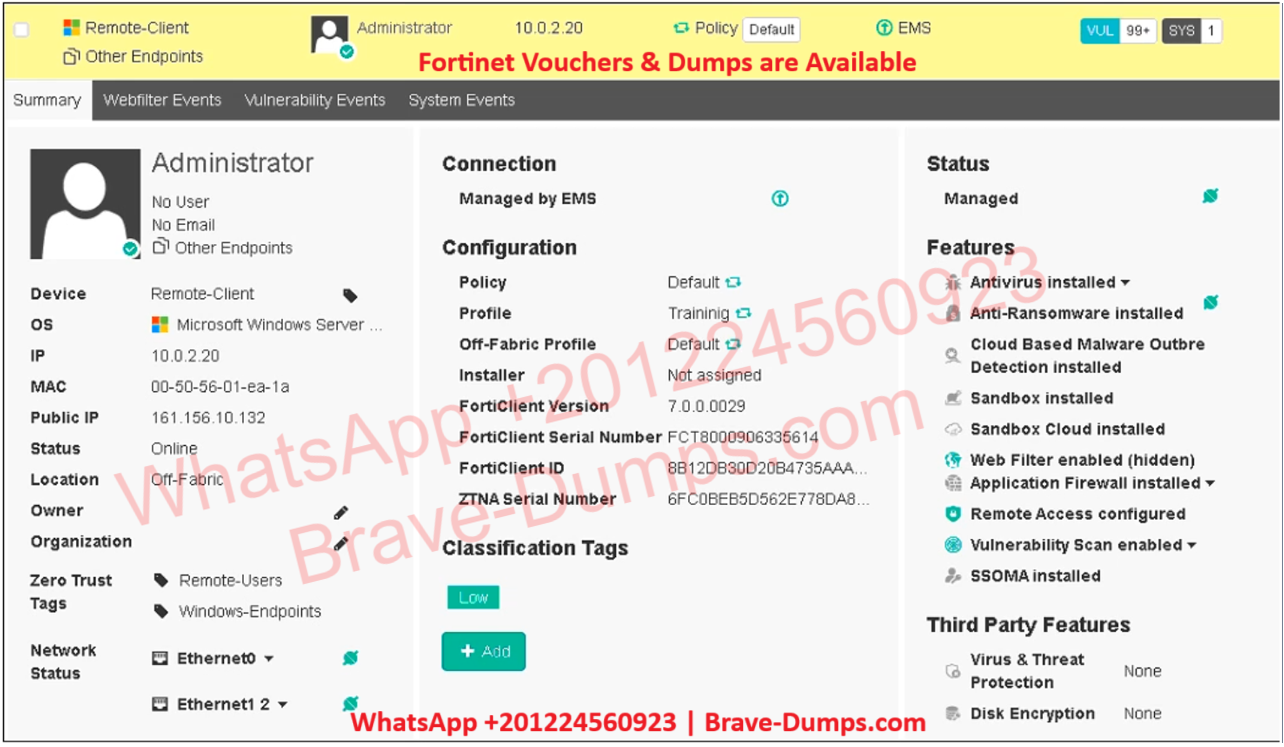
Refer to the exhibit, which shows the endpoint summary information on FortiClient EMS.
What two conclusions can you make based on the Remote-Client status shown above?
(Choose two answers)
- A. The endpoint is classified as at risk.
- B. The endpoint has been assigned the Default endpoint policy.
- C. The endpoint is configured to support FortiSandbox.
- D. The endpoint is currently off-net.
Question #49
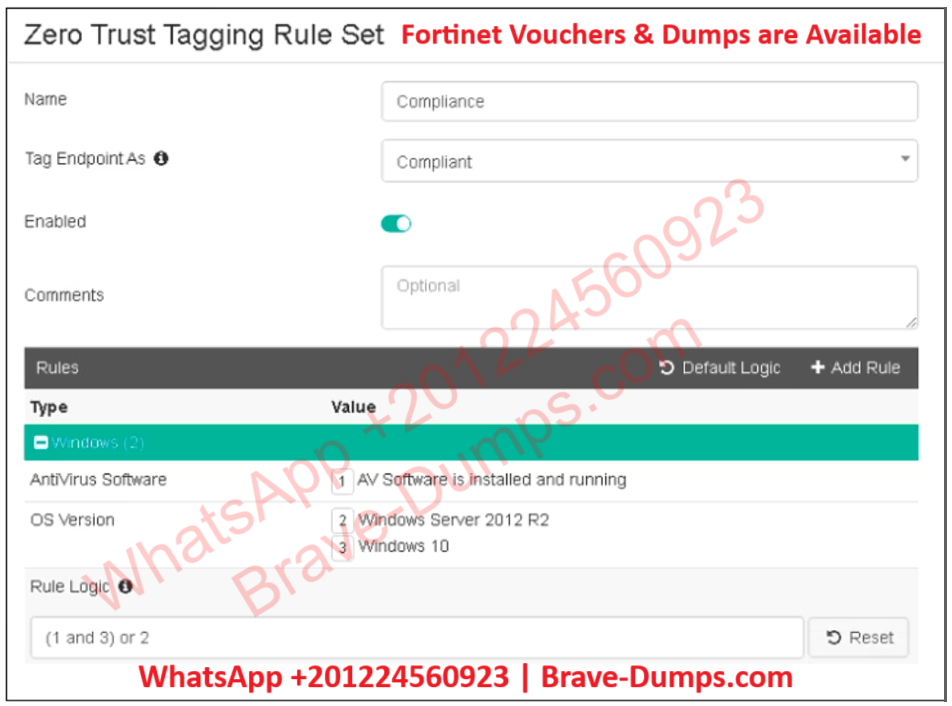
Refer to the exhibit, which shows the Zero Trust Tagging Rule Set configuration.
Which two statements about the rule set are true?
(Choose two answers)
- A. The endpoint must satisfy that only Windows 10 is running.
- B. The endpoint must satisfy that only AV software is installed and running.
- C. The endpoint must satisfy that antivirus is installed and running and Windows 10 is running.
- D. The endpoint must satisfy that only Windows Server 2012 R2 is running.
Question #50
Which two statements about ZTNA destinations are true? (Choose two answers)
- A. FortiClient ZTNA destination encryption is disabled by default.
- B. FortiClient ZTNA destinations use an existing VPN tunnel to create a secure connection.
- C. FortiClient ZTNA destination authentication is enabled by default.
- D. FortiClient ZTNA destinations provides access through TCP forwarding.
- E. FortiClient ZTNA destinations do not support a wildcard FQDN.
Which two VPN types can a FortiClient endpoint user initiate from the Windows command prompt? (Choose two answers)