● FCP - Azure Cloud Security 7.4 Administrator Exam Material
Please note that the exam "FCP - Azure Cloud Security 7.4 Administrato" is no longer offered by Fortinet and is not available for booking through Pearson VUE, so we opened it on free view,
Question #21
Question #22
What are two characteristics of Azure standard public IP addresses? (Choose two answers)
- A. They support the use of availability zones
- B. They can be dynamic or static
- C. They can be used with load balancers of any SKU
- D. They require the configuration of NSGs for inbound traffic
Question #23
Which statement about deploying VMs in a gateway subnet is true? (Choose one answer)
- A. VMs are not allowed in a gateway subnet
- B. VMs can be deployed in a gateway subnet only after you deploy the VPN Gateway
- C. VMs are required in a gateway subnet
- D. VMs are automatically deployed in a gateway subnet
Question #24
What is a limitation of the Network Security Groups (NSGs) in Azure? (Choose one answer)
- A. NSGs allow the filtering of inbound traffic only.
- B. NSGs are applied only to vNICs.
- C. NSGs operate at the application layer, limiting their effectiveness in the network layer.
- D. NSGs cannot be applied to individual virtual machines.
Question #25
In Microsoft Entra ID, what is the primary administrative unit that represents an organization and its relationship with Microsoft's cloud services? (Choose one answer)
- A. Microsoft Entra tenant
- B. Microsoft Entra subscription
- C. Microsoft Entra organization
- D. Microsoft Entra domain
Question #26
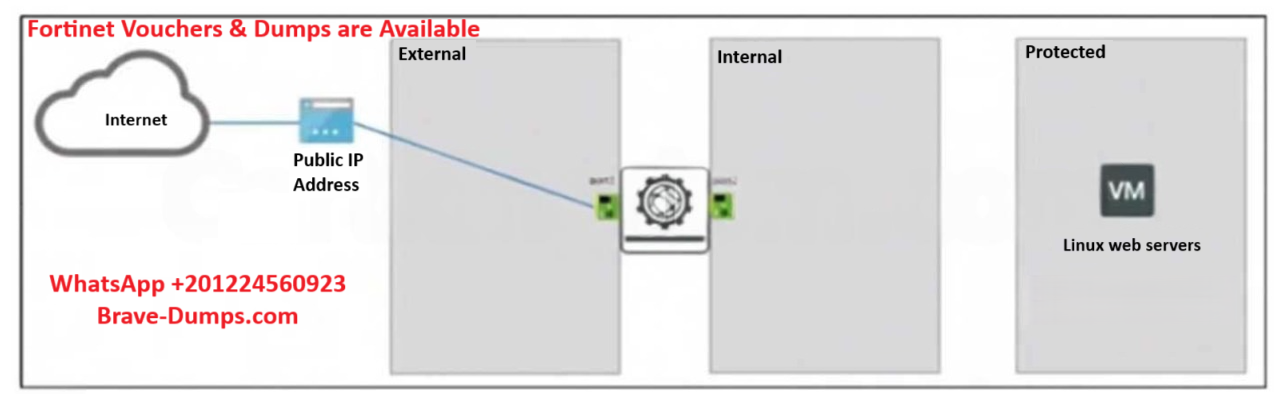
Refer to the exhibit.
Your company runs front-end web servers in Azure. You need to deploy a Linux VM to be used as a web server.
To protect your web servers with a web application firewall (WAF), you deploy FortiWeb to secure applications from web-based attacks.
Which FortiWeb operation mode can you implement for this scenario?
D.
(Choose one answer)
- A. Reverse proxy
- B. True transparent proxy
- C. Passive monitoring
- D. Transparent inspection
Question #27
You want to take advantage of Azure availability zones for your cloud-based Fortinet deployment.
Which two benefits do Azure availability zones provide?
(Choose two answers)
- A. Enhanced protection for application and data in a single Azure region
- B. Improve database performance and reliability
- C. Protect applications and data through high availability with fault isolation and redundancy
- D. Protect applications and data across multiple Azure regions
Question #28
After integrating a FortiGate VM with Azure Route Server, you detect that routes are not propagating successfully.
What initial step could you perform to diagnose the root cause?
(Choose one answer)
- A. Examine the Azure Microsoft Entra ID permissions associated with the FortiGate VM to ensure that correct authentication is being used for BGP peering
- B. Monitor the network latency between the FortiGate VM and Azure Route Server to identify potential communication delays affecting route propagation
- C. Verify that the FortiGate VM is running the latest firmware version
- D. Verify the BGP peering status on both the FortiGate VM and Azure Route Server
Question #29
You deployed a FortiGate active-active with ELB/ILB solution using the template from Azure Marketplace.
What is the purpose of the inbound NAT rules configured in the external load balancer in this deployment?
(Choose one answer)
- A. To load balance the incoming traffic between both FortiGate VMs
- B. To filter inbound traffic before it reaches the FortiGate instances
- C. To forward the health probes to both FortiGate VMs
- D. To allow administrative access to the FortiGate VMs
Question #30
What is a key advantage of the branch-to-hub to hub-to-branch topology in an Azure virtual WAN? (Choose one answer)
- A. Increased security through isolated connections between branches and hubs
- B. Enhanced scalability enables communication between branch offices
- C. Load balancing enabled by the simultaneous connection of each branch to multiple hubs
- D. Improved branch-to-branch communication for faster data transfer
What is the primary purpose of enabling the IP forwarding setting on FortiGate in Azure? (Choose one answer)