● Understanding Cisco Cybersecurity Operations Fundamentals (200-201 CCNA Cybersecurity) Exam Materials
- Less than 250 Verified Questions for Understanding Cisco Cybersecurity Operations Fundamentals Dump (200-201 CCNA Cybersecurity Dump)
- Over 5 Students Passed Understanding Cisco Cybersecurity Operations Fundamentals Exam (200-201 CCNA Cybersecurity Exam) Using This Dump – Join Them Today!
- 100% Score in the Real Understanding Cisco Cybersecurity Operations Fundamentals Exam (200-201 CCNA Cybersecurity Exam) at the Pearson VUE Testing Center
- Over 5 Students Passed Understanding Cisco Cybersecurity Operations Fundamentals Exam (200-201 CCNA Cybersecurity Exam) Using This Dump – Join Them Today!
- 100% Score in the Real Understanding Cisco Cybersecurity Operations Fundamentals Exam (200-201 CCNA Cybersecurity Exam) at the Pearson VUE Testing Center
Question #1
Question #2
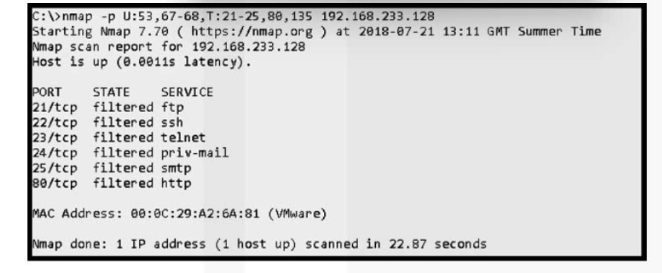
Refer to the exhibit. An attacker scanned the server using Nmap. What did the attacker obtain from this scan? (Choose one answer)
- A. identified a firewall device preventing the port state from being returned
- B. identified open SMB ports on the server
- C. gathered information on processes running on the server
- D. gathered a list of Active Directory users
Question #3
What is the role of indicator of compromise in an investigation? (Choose one answer)
- A. It is nonforensic data, which is easy to detect.
- B. It identifies potentially malicious activity on a system or network.
- C. It helps answer the question of why the attack took place
- D. It describes what and why something happened.
Question #4
Which evasion method involves performing actions slower than normal to prevent detection? (Choose one answer)
- A. traffic fragmentation
- B. tunneling
- C. resource exhaustion
- D. timing attack
Question #5
During which phase of the forensic process are tools and techniques used to extract information from the collected data? (Choose one answer)
- A. reporting
- B. investigation
- C. collection
- D. examination
Question #6
An engineer configured regular expression ".*.([Dd][Oo][Cc][Xx][L][Ss][Pp][Pp][Tt]) HTTP/1.[01]" on Cisco ASA firewall. What does this regular expression do? (Choose one answer)
- A. It captures .doc, .xls, and .pdf files in HTTP v1.0 and v1.1.
- B. It captures Word, Excel, and PowerPoint files in HTTP v1.0 and v1.1.
- C. It captures documents in an HTTP network session.
- D. It captures .doc, .xls, and .ppt files extensions in HTTP v1.0.
Question #7
During a security audit, an engineer finds evidence of an attacker exploiting weaknesses in the TCP/IP stack by sending malformed packets from the host "scanner054017328.local." The attack aims to disrupt normal protocol operations by exploiting protocol vulnerabilities. Which type of network attack is utilized? (Choose one answer)
- A. Man-in-the-Middle
- B. Protocol-based
- C. Distributed Denial of Service
- D. Denial of Service
Question #8
Which tool is used by threat actors on a webpage to take advantage of the software vulnerabilities of a system to spread malware? (Choose one answer)
- A. vulnerability kit
- B. exploit kit
- C. script kiddie kit
- D. root kit
Question #9
What matches the regular expression c(rgr)+e? (Choose one answer)
- A. ce
- B. crgrrgre
- C. c(rgr)e
- D. crgr+e
Question #10
Which list identifies the information that the client sends to the server in the negotiation phase of the TLS handshake? (Choose one answer)
- A. ClientStart, ClientKeyExchange, cipher-suites it supports, and suggested compression methods
- B. ClientStart, TLS versions it supports, cipher-suites it supports, and suggested compression methods
- C. ClientHello, TLS versions it supports, cipher-suites it supports, and suggested compression methods
- D. ClientHelllo, ClientKeyExchange, cipher-suites it supports, and suggested compression methods
A SOC analyst is investigating an incident that involves a Linux system that is identifying specific sessions. Which identifier tracks an active program? (Choose one answer)