● NSE 7 - SASE 26 Architect Exam Materials
Question #1
Question #2
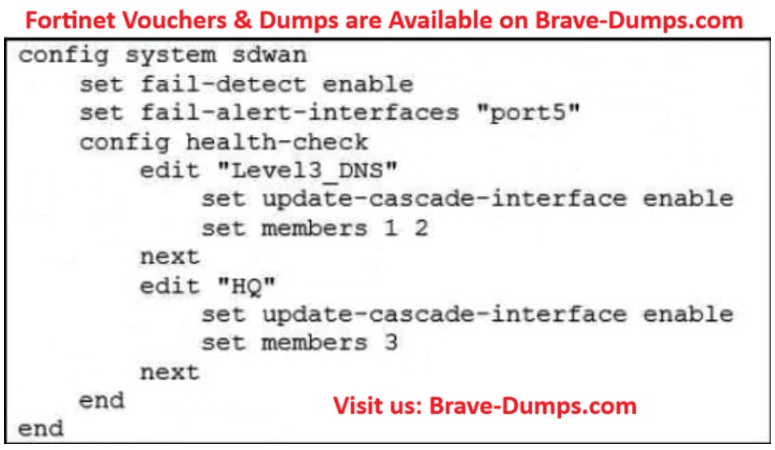
Refer to the exhibit.
Which action will FortiGate take if it detects SD-WAN members as dead?
(Choose one answer)
- A. FortiGate sends alert messages through port5 when it detects any SD-WAN member as dead.
- B. FortiGate sends alert messages through port5 when it detects all SD-WAN members as dead.
- C. FortiGate brings down port5 after it detects all SD-WAN members as dead.
- D. FortiGate brings down port5 after it detects that SD-WAN member 3 is down
Question #3
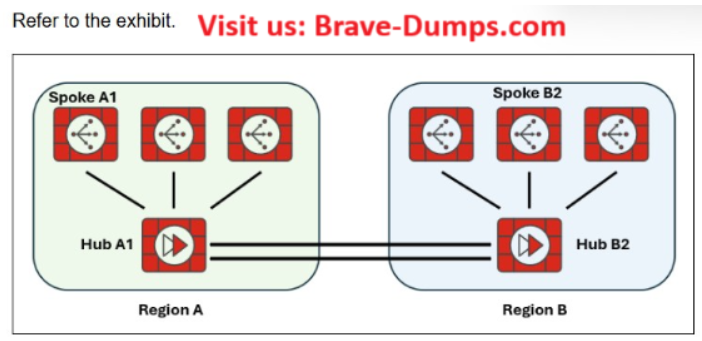
Refer to the exhibit.
Two hub-and-spoke groups are connected through redundant site-to-site IPsec VPNs between Hub 1 and Hub 2.
Which two configuration settings are required for spoke A1 to establish an auto-discovery VPN (ADVPN) shortcut with spoke B2?
(Choose two answers)
- A. On the spokes, auto-discovery-sender must be enabled on the IPsec VPNs to hubs.
- B. On the hubs, auto-discovery-receiver must be enabled on the IPsec VPNs to spokes.
- C. On the spokes, auto-discovery-receiver must be enabled on the IPsec VPNs to the hub.
- D. On the hubs, auto-discovery-forwarder must be enabled on the IPsec VPNs to hubs.
Question #4
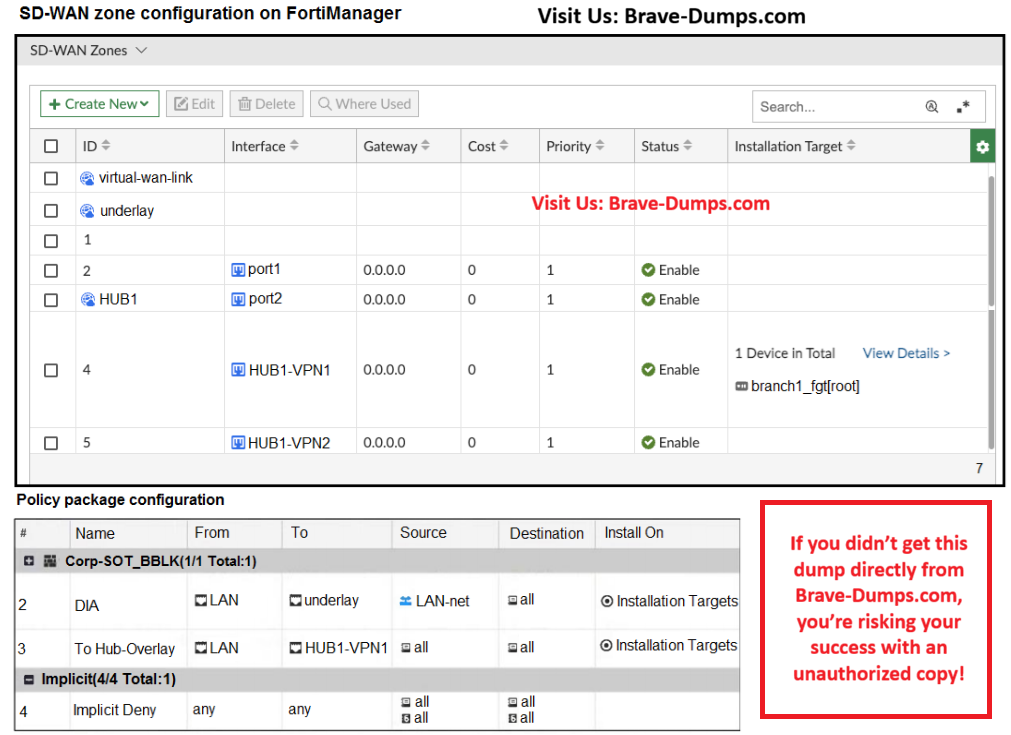
Refer to the exhibits.
The SD-WAN zone configuration of an SD-WAN template prepared on FortiManager and the policy package configuration are shown.
When you try to install the configuration changes, FortiManager displays an error message.
How can you fix the issue?
(Choose one answer)
- A. Configure branch1_fgt as the installation target for policy 3.
- B. Configure HUB1 as the destination of policy 3.
- C. Configure a normalized interface for the IPsec tunnel HUB1-VPN1.
- D. Configure both HUB1-VPN1 and HUB1-VPN2 as the destination of policy 3.
Question #5
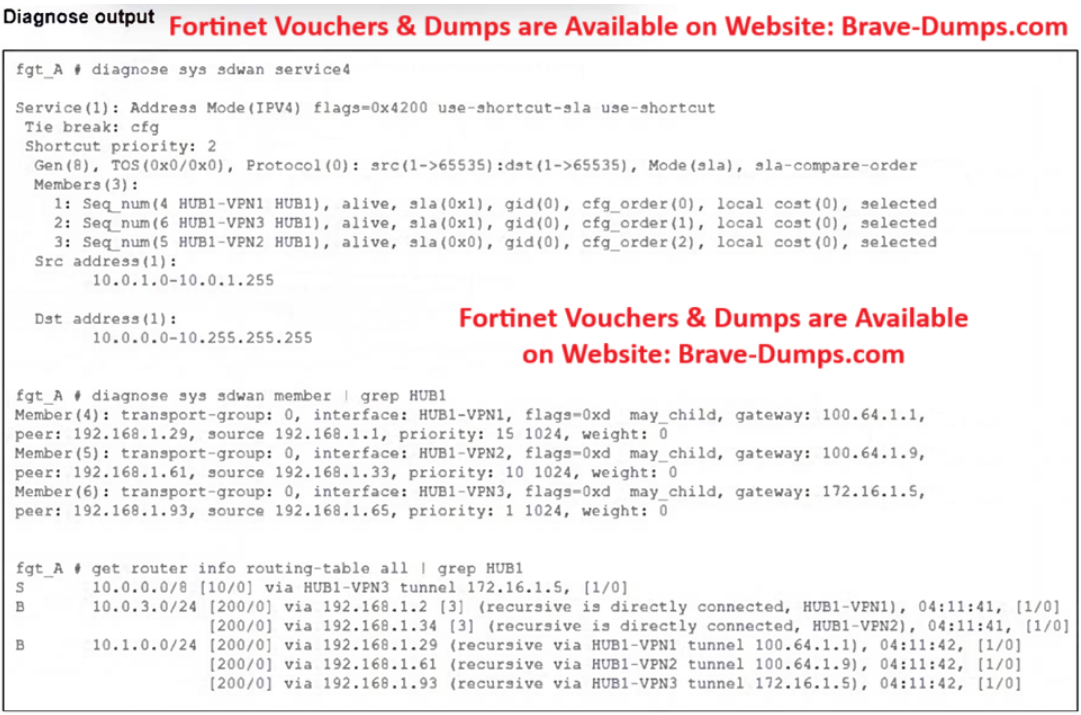
Refer to the exhibit.
An administrator is troubleshooting SD-WAN on FortiGate. A device behind branch1_fgt generates traffic to a few destinations in the 10.0.0.0/8 network.
The administrator expects the traffic to match SD-WAN rule ID 1 and be routed over HUB1-VPN1. However, the traffic is routed over HUB1-VPN3.
Based on the output shown in the exhibit, which two reasons, individually or together, could explain the observed behavior?
(Choose two answers)
- A. HUB1-VPN1 does not have a valid route to the destination.
- B. The traffic matches a regular policy route configured with HUB1-VPN3 as the outgoing device.
- C. HUB1-VPN3 has a higher member configuration priority than HUB1-VPN1.
- D. HUB1-VPN3 has a lower route priority value (higher priority) than HUB1-VPN1.
Question #6
How is the geofencing feature used on FortiSASE? (Choose one answer)
- A. To allow or block remote user connections to FortiSASE points of presence (POPs) based on source country
- B. To restrict application access based on time of day in specific countries
- C. To monitor and block access to personal content from specific countries
- D. To encrypt data at rest on endpoints located in specific countries
Question #7
In the context of SD-WAN, the terms underlay and overlay are commonly used to categorize links.
Which two statements about underlay and overlay links are correct?
(Choose two answers)
- A. FortiLink interface is considered an underlay link.
- B. A VLAN is a type of overlay link.
- C. Only wired connections can be used as underlay links.
- D. Overlay links provide routing flexibility.
- E. Wireless connections can be used to build overlay links.
Question #8
A customer wants to ensure secure access for private applications for their users by replacing their VPN.
Which two SASE technologies can you use to accomplish this task?
(Choose two answers)
- A. Secure web gateway (SWG) and cloud access security broker (CASB)
- B. SD-WAN on-ramp
- C. Zero trust network access (ZTNA)
- D. Secure SD-WAN
Question #9
Which component, typically categorized under network edge connectivity rather than cloud-delivered security controls, is incorporated as a foundational element within a secure access service edge (SASE) architecture but is not considered part of a security service edge (SSE) framework? (Choose one answer)
- A. Zero trust network access (ZTNA)
- B. Software-Defined WAN (SD-WAN)
- C. Secure web gateway (SWG)
- D. Cloud access security broker (CASB)
Question #10
An administrator is enforcing endpoint network lockdown using FortiSASE to ensure that devices access the internet only under defined security conditions. The lockdown state must be released automatically when the endpoint meets specific trust or connectivity criteria.
Which two conditions can trigger the release of the network lockdown on an endpoint?
(Choose two answers)
- A. The endpoint is detected as being on-net.
- B. The endpoint establishes a connection to the FortiSASE tunnel.
- C. The endpoint is rebooted.
- D. The endpoint is evaluated as compliant using security posture tags.
Refer to the exhibit.
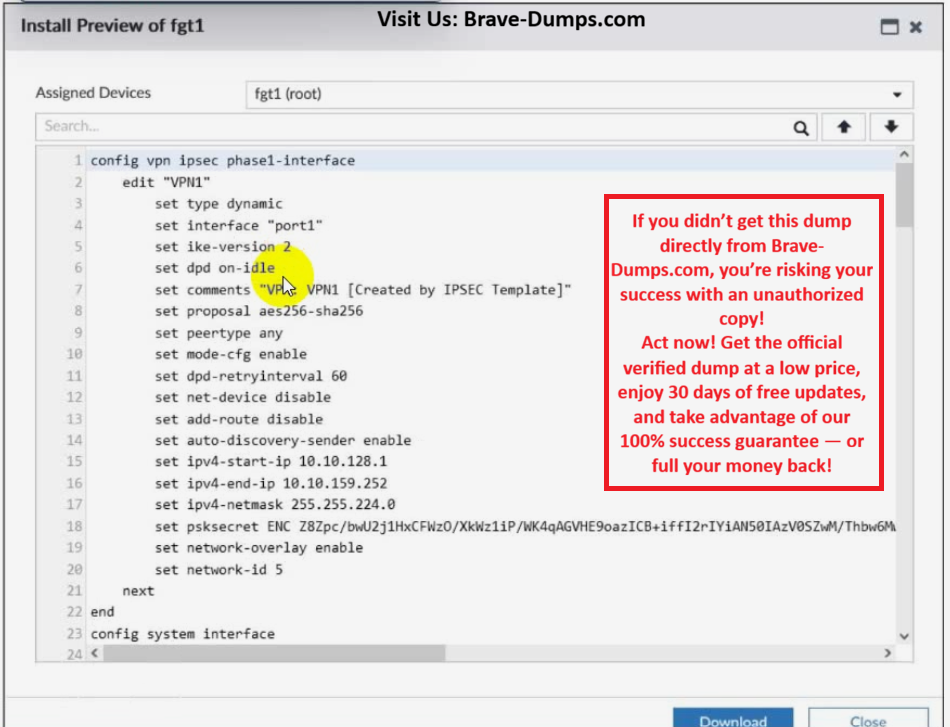
You used the SD-WAN overlay orchestrator to prepare an IPsec tunnels configuration for a hub-and-spoke SD-WAN topology. The exhibit shows the FortiManager installation preview for one FortiGate device.
Based on the exhibit, which statement correctly describes the configuration applied to the FortiGate device? (Choose one answer)