● Designing, Deploying and Managing Network Automation Systems (350-901 AUTOCOR) Exam Materials
Hello Dears, these questions were captured from the real Designing, Deploying and Managing Network Automation Systems (350-901 AUTOCOR) Exam. They can certainly help you prepare for the exam; however, they are not considered a 100% validated or fully corrected dump and passing cannot be guaranteed, for this reason, we are offering this material at a lower price, please note that this clarification applies only to the Designing, Deploying and Managing Network Automation Systems (350-901 AUTOCOR) Exam Materials, All other dumps available on our website are fully guaranteed, once the dump is fully prepared and validated, we will write another comment, Good luck with your exam preparation.
Question #1
Question #2
A network management stack is being refactored for enhanced visibility and automation. To achieve effective reporting for microservice health monitoring, system log outputs must be directed to a RESTful webhook receiver. Operational requirements specify timely and reliable log notification without modifying core network devices. Which logging approach meets the requirements? (Choose one answer)
- A. SMB share mount for file-based log access
- B. push-based notification handler for operational telemetry
- C. email-based notification script for periodic alerts
- D. polling mechanism using SNMP table queries
Question #3
Which outcome results from configuring pipelines for AI learning from code changes in the lifecycle of network automation using AI-assisted code approaches? (Choose one answer)
- A. smaller margin for configuration divergence
- B. static templates for policy enforcement
- C. delayed notification of unusual activities
- D. adaptive improvement in decision recommendations
Question #4
A new set of automated scripts for infrastructure management needs an advanced mechanism for logging operational events. For rapid fault isolation, large log volumes must be handled efficiently while data is synchronized to an enterprise cloud logging service. The design must avoid the local log file to prevent storage issues. Which mechanism must be implemented to meet the requirements? (Choose one answer)
- A. periodic uploads by file transfer protocol
- B. stream forwarding with buffer management and acknowledgement
- C. manual CSV exports per scheduled interval
- D. syslog forwarding with disabled transport security
Question #5
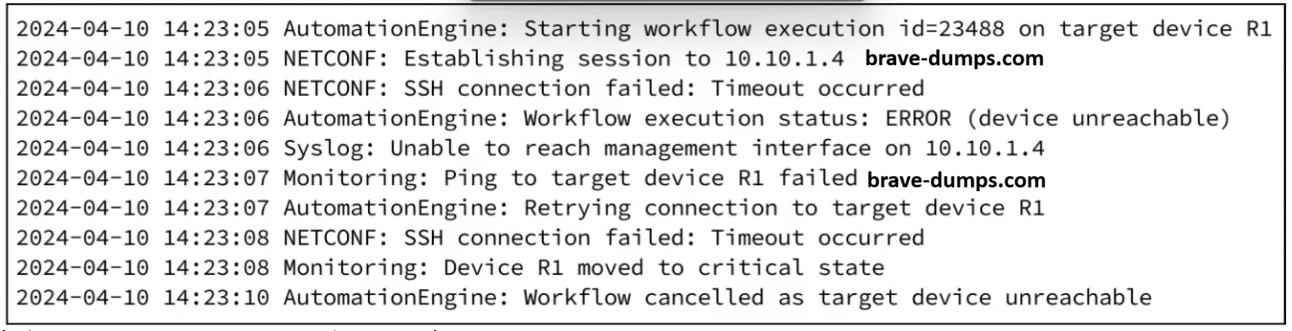
Refer to the exhibit. A network automation job was scheduled to run during the standard maintenance window on device R1. The job was configured to use connection method NETCONF, and execution was triggered from the orchestrator server. During the maintenance window, the system logs indicate that the workflow could not reach its intended target. Further investigation into monitoring alerts reveals persistent connection failures for the duration of the job window. Operations reported that other devices were reachable from the server. The orchestration logs do not show issues with job scheduling or agent workflows. What is the root network automation issue? (Choose one answer)
- A. The NTP server is unreachable from the device.
- B. Incorrect credentials prevent session establishment.
- C. The management firewall is missing an access rule.
- D. Hostname mismatch is detected on controller.
Question #6
Within a multidomain enterprise network, administrators introduced context-aware routers to facilitate orchestration between disparate segments. Integrated with proximity event triggers, this system determines operational sequences for connectivity services. Which approach interprets risk exposure introduced by AI-based automation in this context? (Choose one answer)
- A. scaling operation draft
- B. port assembly core
- C. component verification array
- D. risk domain mapping
Question #7
A developer must integrate changes made in the release candidate branch into a separate project branch for testing purposes. The updated configuration files have been reviewed and approved. The goal is to apply the modifications from a commit with updated version control files without merging unrelated history. Which action achieves the goal? (Choose one answer)
- A. Choose an action that undoes all differences since the last checkpoint.
- B. Use a command that combines entire branch histories without separation.
- C. Use a command that stashes current modifications for later.
- D. Use a command that replays an update from a commit onto the present branch.
Question #8
While maintaining a continuous delivery pipeline, engineers detect errors just before a new deployment. The staging area must be updated to discard certain modifications, but all previous changes must remain intact and unaltered. What successfully rolls back those specific changes? (Choose one answer)
- A. fast-forward merge strategy
- B. hard reset command
- C. commit history rewind
- D. soft reset application
Question #9
A project team must maintain code consistency across several feature developments using forked development for collaborative workflows. Recently, multiple contributors finished their work and pushed to remote repositories. Three-way reconciliation is the most efficient strategy to ensure a single commit history during integration and keep accurate conflict detection for critical files. What must be used to meet the requirements? (Choose one answer)
- A. recursive submodule update
- B. hard reset after pull
- C. shallow clone adjustment
- D. conflict-aware merge with squash
Question #10
A deployment project targets infrastructure that uses multivendor platforms. The team incorporated change validation into their pipeline and applied pyATS test discovery as a critical part of their process. All modifications are subject to checks for accuracy, and unauthorized deviations must be detected automatically. Reducing human oversight while maintaining traceable records is mandated. Which task integration meets the requirements? (Choose one answer)
- A. traffic shaping policies from route reflectors
- B. access list propagation via exported templates
- C. automated scenario mapping prior to staging
- D. time zone assignment using individual timers
A network engineering project involves automating device onboarding, and the code must use a dedicated input schema validator for increased reliability. The engineers must ensure that input is strictly checked and that malicious file paths cannot be injected by external sources. Security reviewers requested that validation controls be implemented early in the automation logic. Which approach integrates robust input assessment into this workflow? (Choose one answer)