● NSE 5 - FortiAppSec Cloud 26 Administrator Materials
Dear valued clients,
We have passed the NSE 5 - FortiAppSec Cloud 26 Administratotr Exam, does this mean the dump is fully validated and ready? Not yet.
We need to take and pass the exam 2 more time to ensure that we have covered the entire question pool. We will confirm the final validation status soon.
Please keep waiting for our final confirmation. Good luck!
Question #1
Question #2
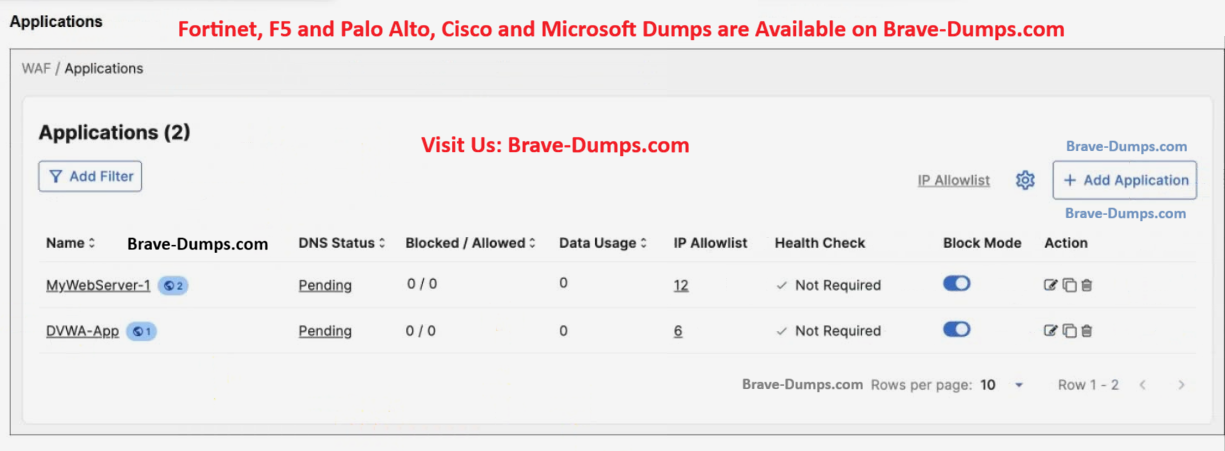
Refer to the exhibit.
An administrator recently onboarded two web applications to be protected by FortiAppSec Cloud WAF.
What are the three reasons their DNS Status is still Pending?
(Choose three answers)
- A. The administrator has not modified their A record to direct all traffic for their domain to FortiAppSec Cloud.
- B. The administrator has not restricted direct-to-IP traffic using the IP addresses listed in the IP Allowlist.
- C. The administrator has not refreshed the browser page since manually triggering an update to the DNS status.
- D. The administrator has not added a CNAME record to direct all traffic for their domain to FortiAppSec Cloud.
- E. The administrator has not sent any traffic to FortiAppSec Cloud. The DNS status will change to OK once FortiAppSec Cloud detects traffic.
Question #3
When FortiAppSec Cloud detects a violation against known signatures, such as a SQL injection or cross-site scripting (XSS) attack, it can execute preconfigured protective responses.
Which two actions can an administrator take when a violation is detected?
(Choose two answers)
- A. Deny & Redirect
- B. Alert
- C. Quarantine
- D. Alert & Deny
Question #4
An administrator has successfully onboarded several web applications to FortiAppSec Cloud.
Which two initial deployment settings should the administrator configure next?
(Choose two answers)
- A. The administrator should apply a preconfigured template based on the type of application that was onboarded.
- B. The administrator should restrict direct-to-IP traffic to web applications to only the IP addresses listed in the application's IP allow lists.
- C. The administrator should enable Block Mode for all onboarded web applications.
- D. The administrator should update the DNS records for the web applications to point to FortiAppSec Cloud.
Question #5
When configuring bot protection in FortiAppSec Cloud, which action should an administrator select to verify whether an incoming request is sent by a real human using an interactive challenge? (Choose one answer)
- A. Insert CAPTCHA
- B. ML-Based Standby
- C. Inject JavaScript collector
- D. Suspend
Question #6
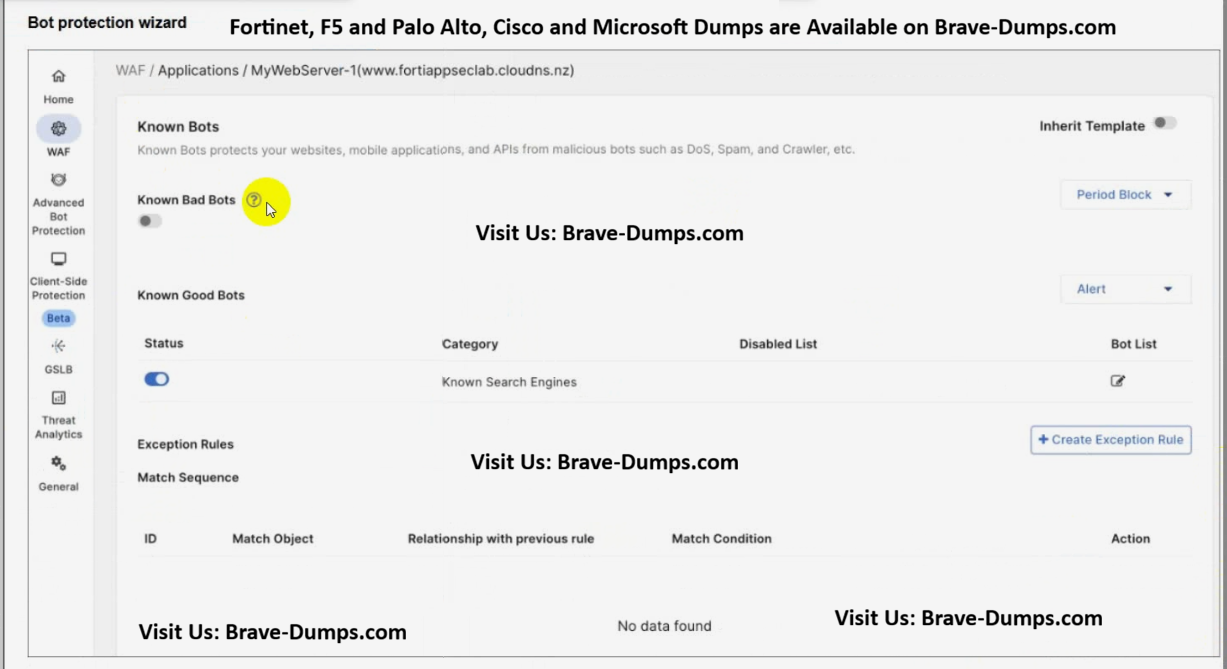
Refer to the exhibit.
An administrator is configuring bot protection for their organization's web application.
Which statement about the current configuration is true?
(Choose one answer)
- A. All requests from known good bots are accepted and a log message is generated.
- B. All requests from known bad bots are blocked and all subsequent requests are blocked for 10 minutes.
- C. All invalid requests from known good bots are recorded in the attack log.
- D. All requests from known bad bots are blocked and logged.
Question #7
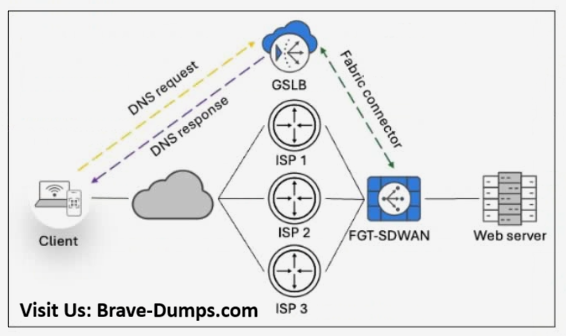
Refer to the exhibit.
An administrator is using the FortiGate Fabric Connector on FortiAppSec Cloud to synchronize the virtual servers and SD-WAN interfaces from FortiGate to FortiAppSec Cloud.
Which three additional configuration steps are required on FortiAppSec Cloud to ensure SD-WAN inbound load balancing across all three ISPs?
(Choose three answers)
- A. Configure health checks for each virtual server.
- B. Manually select the SDWAN-InBandwidth load balancing method.
- C. Create a virtual server pool.
- D. Create an FQDN object on the topology page.
Question #8
The FortiAppSec Cloud Threat Analytics engine is tracking an active security incident.
At 14:00, an attacker using source IP address 192.0.2.50 generates a SQL injection alert, which the threat analytics engine logs as Attack Sequence A.
If the same attacker (192.0.2.50) launches a cross-site scripting (XSS) attack at 15:15, how will the Threat Analytics engine categorize this new event?
(Choose one answer)
- A. It will discard the event because the idle timeout threshold forces the engine to ignore subsequent traffic from that IP for 24 hours.
- B. It will append the event to Attack Sequence A because SQL injections and XSS attacks share similar web application attack characteristics.
- C. It will automatically start a new attack sequence because too much time has elapsed since the last event in Sequence A.
- D. It will append the event to Attack Sequence A because it originates from the same source IP.
Question #9
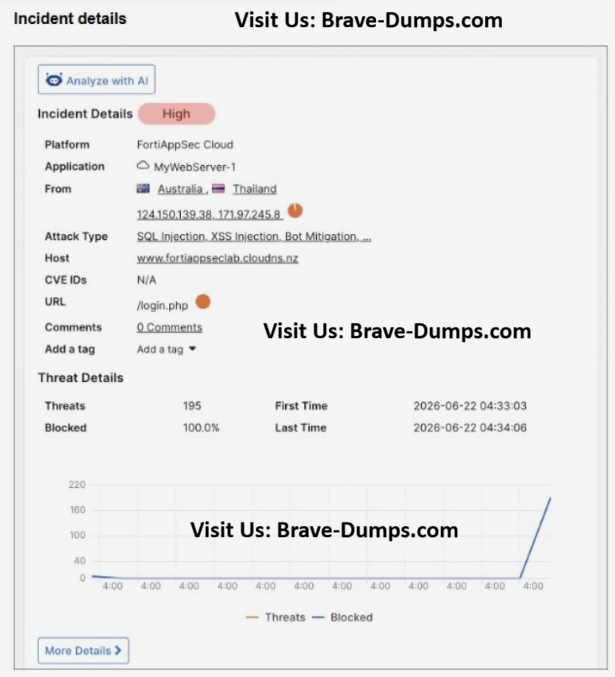
Refer to the exhibit.
An administrator is performing incident analysis on a FortiAppSec Cloud Threat Analytics Incident.
What can they determine from the data displayed?
(Choose one answer)
- A. The incident was created because its severity level is equal to or higher than High.
- B. The incident grouped attacks from Australia and Thailand because they shared similar attack characteristics.
- C. The incident was created by the FortiAI Assistant.
- D. The incident is split into three parts, one for each attack type.
Question #10
Which two statements best describe the platform architecture and core capabilities of FortiAppSec Cloud? (Choose two answers)
- A. It combines machine learning and traditional signatures to block OWASP Top 10 threats, zero-days, and malicious bots.
- B. It acts as a layer 3 and layer 4 network firewall to secure SD-WAN connectivity and IPsec VPN tunnels.
- C. It leverages threat analytics to autonomously generate and apply recommended web application security profiles without requiring administrator intervention.
- D. It uses a cloud reverse proxy architecture to inspect and mitigate threats to public web applications and APIs before they reach the origin.
FortiAppSec Cloud uses machine learning models to detect and mitigate zero-day attacks and sophisticated threats.
Based on its operational workflow, which three statements accurately describe how FortiAppSec Cloud identifies and processes potential security threats? (Choose three answers)