● NSE 5 - FortiSASE and SD-WAN 26 Core Administrator Exam Materials
Dear valued clients,
We have passed the NSE 5 - FortiSASE and SD-WAN 26 Core Administrator Exam for the second time, does this mean the dump is fully validated and ready? Not yet.
We need to take and pass the exam 1 more time to ensure that we have covered the entire question pool. We will confirm the final validation status soon.
Please keep waiting for our final confirmation. Good luck!
Question #1
Question #2
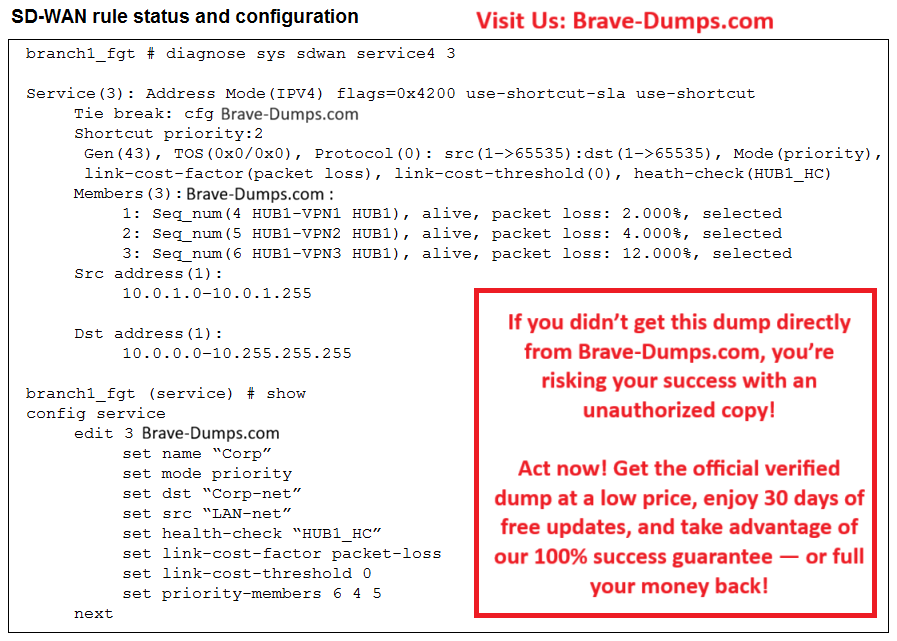
Refer to the exhibit.
The SD-WAN rule status and configuration is shown.
Based on the exhibit, which change in the measured latency will first make HUB1-VPN3 the new preferred member?
(Choose one answer)
- A. When HUB1-VPN1 has a latency of 200 ms
- B. When HUB1-VPN3 has a latency of 90 ms
- C. When HUB1-VPN3 has a latency of 80 ms
- D. When HUB1-VPN3 has a lower latency than HUB1-VPN1 and HUB1-VPN2
Question #3
An SD-WAN member is no longer used to steer SD-WAN traffic. You want to update the SD-WAN configuration and delete the unused member.
Which action should you take first?
(Choose one answer)
- A. Remove the member from the performance service-level agreement (SLA) definitions.
- B. Disable the interface.
- C. Delete static route definitions for that interface.
- D. Move the SD-WAN member to the virtual-wan-link zone.
Question #4
Which two statements correctly describe what happens when traffic matches the implicit SD-WAN rule? (Choose two answers)
- A. The traffic is distributed, regardless of weight, through all available static routes.
- B. The session information output displays no SD-WAN service id.
- C. Traffic is load balanced using the algorithm set for the v4-ecmp-mode setting.
- D. FortiGate flags the session with may_dirty and vwl_default.
- E. Traffic does not match any of the entries in the policy route table.
Question #5
What is the primary function of FortiView on FortiSASE? (Choose one answer)
- A. Provides consolidated consoles to analyze security events over time using graphical or text-based log views.
- B. Presents raw log data in graphical format only, without sorting criteria or aggregated views.
- C. Generates real-time alerts for security events and presents them in a single text-based console without metadata.
- D. Displays individual logs on the GUI without aggregation, allowing administrators to sort events by time only.
Question #6
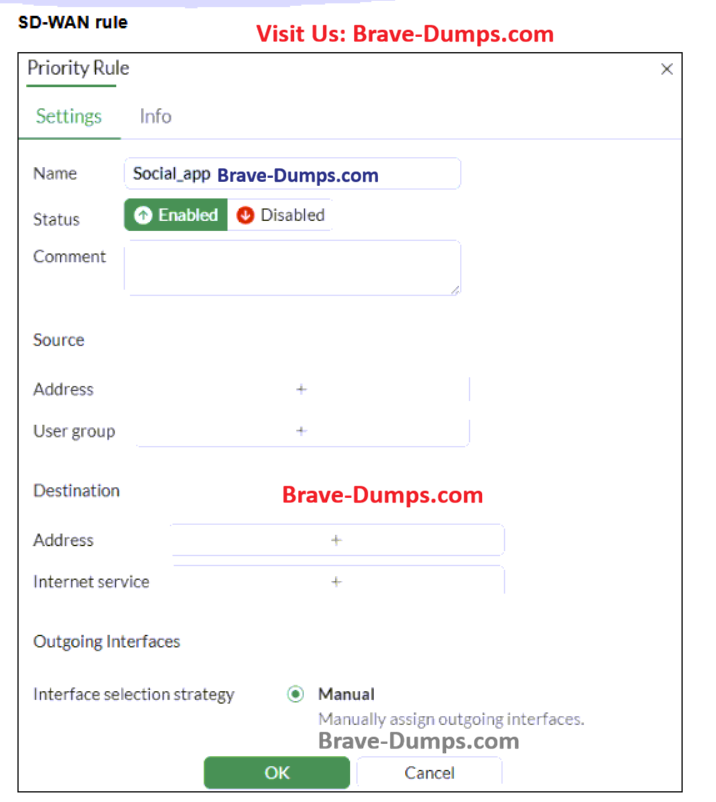
Refer to the exhibit.
You configure SD-WAN on a standalone FortiGate device. You want to create an SD-WAN rule that steers traffic related to Facebook and LinkedIn through the less costly internet link.
What must you do to set Facebook and LinkedIn applications as destinations from the GUI?
(Choose one answer)
- A. Install a license to allow applications as destinations of SD-WAN rules.
- B. In the Internet service field, select Facebook and LinkedIn.
- C. Enable the visibility of the applications field as destinations of the SD-WAN rule.
- D. You cannot configure applications as destinations of an SD-WAN rule on a standalone FortiGate device.
Question #7
Which three authentication sources support secure identity verification and access control for FortiSASE remote users? (Choose three answers)
- A. Security Assertion Markup Language (SAML)
- B. Terminal Access Controller Access-Control System Plus (TACACS+)
- C. OpenID Connect (OIDC)
- D. Remote Authentication Dial-in User Service (RADIUS)
- E. Lightweight Directory Access Protocol (LDAP)
Question #8
Which two configurations are required for Agentless ZTNA to work? (Choose two answers)
- A. SD-WAN Private Access SPA
- B. Proxy user single sign-on (SSO)
- C. FortiClient Agent
- D. FortiGate with ZTNA proxy
Question #9
A network administrator is deploying FortiSASE for Secure Internet Access (SIA) and needs to onboard edge devices that can be centrally provisioned and managed with policy enforcement.
Which two device types are supported for FortiSASE SIA device provisioning and policy management?
(Choose two answers)
- A. FortiAP
- B. FortiBranchSASE
- C. FortiGate-VM
- D. FortiNAC
Question #10
Which statement about FortiSASE CASB capabilities is true? (Choose one answer)
- A. FortiSASE provides only inline CASB.
- B. FortiSASE provides CASB capabilities only through Security Fabric integration.
- C. FortiSASE provides only API-based CASB.
- D. FortiSASE provides both API-based CASB and inline CASB.
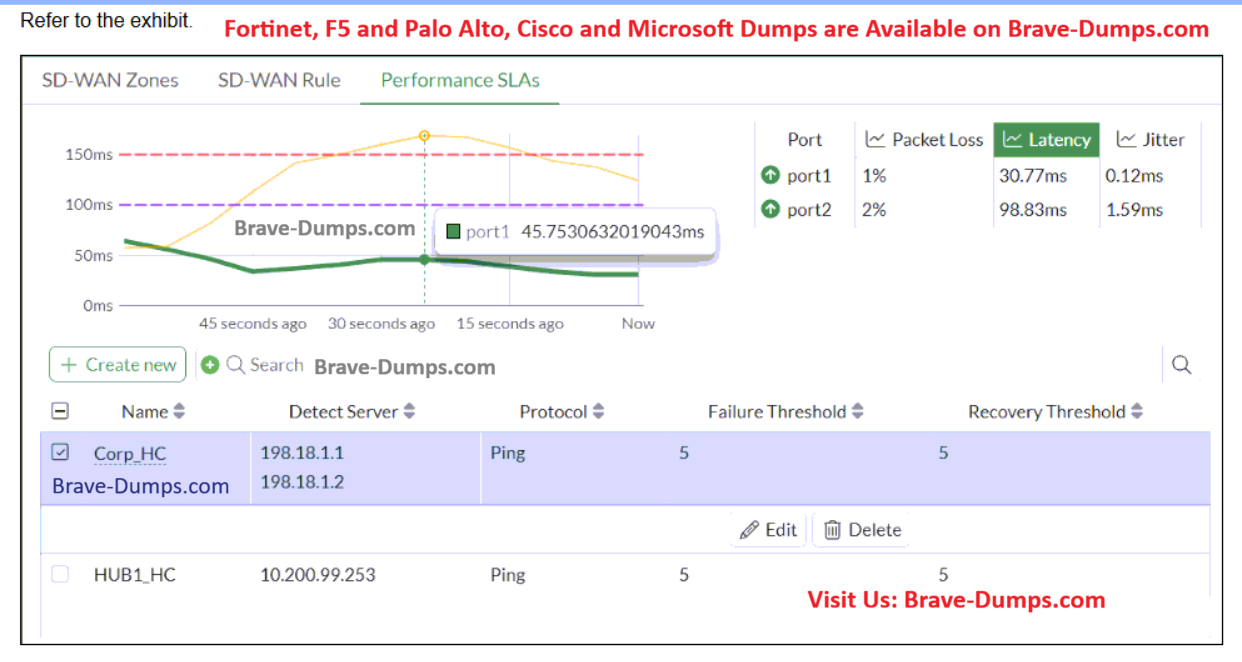
Refer to the exhibit.
Which conclusion can you draw from the exhibit? (Choose one answer)